This Shenzhen corporate promotional video interview checklist does not begin with “grand establishing shots” or an equipment list. It first defines the business throughline, interviewees, authentic work actions, and divisible answers, then marks how they will be used on the website, YouTube, and LinkedIn. This article focuses on interviews and visual evidence; the linked solution page covers the full corporate-video team, on-site execution, and version delivery.
First, Write the Promotional Video Task as Three Filmable Statements

Before a pitch, the brand owner and marketing director should write at least three statements: who the customer is, what the customer must believe, and what action the customer should take afterward. A technology service company, for example, should not merely “show the office environment”; it should let potential customers understand how a project request is handled, who makes the judgment, and how the result is handed over.
- Business throughline:Break the service process into one observable action, such as request intake, on-site judgment, solution confirmation, or delivery review.
- Human lead:Identify who can articulate the critical judgment and who can perform one proving action in the workplace.
- Usage scenario:Distinguish the website homepage, sales visits, long-form YouTube version, and short LinkedIn version. Do not make one video carry every task.
The creative director’s first choice is simple: if a positioning statement cannot map to one human action or one on-site detail, leave it out of the script for now.
When Reviewing Samples, I Look for Only Three Types of Evidence
The first is “Can they ask questions?” A good team does not ask only “How many years has the company operated?” It probes which step customers most often misunderstand, how business owners make decisions, and which materials reassure unfamiliar customers. The second is “Can they turn words into a scene?” When an interview mentions collaboration, the image should show a meeting, handoff, annotation, or real operation rather than a succession of empty shots.
The third is “Can they preserve versions for different uses?” Do not review samples only for cinematography; also check whether the opening frame can stand alone, whether subtitles work in muted environments, and whether spoken content and ambient sound can be separated.LinkedIn Video Advertising Specifications cover landscape, square, and vertical ratios. If a team does not discuss aspect ratios and subtitles early, post-production often has no option but to force a crop. If the project also serves an overseas market for a brand expanding abroad, the brief should specify landscape and vertical versions, Shorts, and the version matrix.
The Interview Outline Determines Whether the Film Has Business Warmth
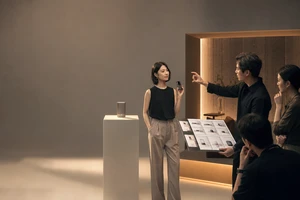
Do not leave interviews to improvisation on set. Give every on-camera person three questions in advance: what customers truly worry about, when you make a judgment, and how that judgment changes the next step. The marketing owner explains brand direction, the business owner explains delivery actions, and a customer or frontline colleague describes real use. The video avoids becoming a string of slogans only when each role owns one proof task.
On a Shenzhen set, I place interview positions and the business workflow on the same shooting sheet: first check light and noise; then determine movement and whether products or documents may appear; finally arrange one work action that stands without the interview. A common on-set event is that the site owner changes position at the last minute and the camera must move. The director must still explain “why we changed” rather than merely saying “this looks more premium.”
Write Shenzhen Shooting Conditions into the Pitch Instead of Leaving Them as Verbal Promises
Rework on a corporate promotional video is most often caused not by the camera but by on-site collaboration. Before filming, confirm who opens the office or workstation, where audio may be recorded, how much uninterrupted time on-camera people can provide, whether customer or employee releases are needed, and which product and document information may not be filmed. Shenzhen offices, showrooms, and light-industrial spaces vary greatly, so studio conditions, attendance coordination, and last-minute scheduling must be recorded in the quotation and timeline.
I prefer a team that writes “What if this person is unavailable?”, “What if sound cannot be recorded on site?”, and “What if the business action is canceled?” into its alternatives. Such contingency planning demonstrates execution capability better than a page of attractive storyboards and is closer to real procurement.
The Finished Video’s Uses Determine How Shots Must Be Preserved
A website video needs a stable thumbnail, a crawlable player or embed structure, and a title and description consistent with the page.Google Search Central’s Video Guidelines explicitly recommend stable media and thumbnail URLs. During shooting acceptance, therefore, check the cover, video file, page title, and description together rather than accepting only the exported MP4.
The YouTube version must lock down container, encoding, frame rate, and audio in advance.YouTube’s Official Upload Encoding Recommendations clearly specify MP4, H.264, progressive scan, and preservation of the source frame rate. If overseas customers are included, English subtitles should be a separate deliverable; YouTube’s subtitle guidance also requires subtitle files with corresponding timecodes.
This is why I do not recommend “shoot one main film first, then decide how to adapt it.” The main film, 30-second sales version, vertical social version, and muted captioned version should identify at storyboard stage which shots must remain and which interviews can be divided, forming a reusable asset pool and version matrix. Shenzhen’s 2026 plan proposes cultivating digital creative industry clusters and strengthening the film and television industry. The industrial environment described in the Shenzhen Government Gazette likewise requires teams to connect creativity with deliverable content assets. For cross-border ecommerce or overseas sales teams, the ending must also check multilingual subtitles, landing pages, and action information understandable to overseas users.
Final Acceptance: Check Whether the Team Preserved Reusable Judgments
Do not judge delivery only by whether the image feels “premium.” Check item by item: people’s names and titles, key business actions, subtitles and voiceover, music rights, file naming, landscape and vertical ratios, website cover, subtitle files, and reusable interview segments. If later work will combine live action, post-production, and AI extensions, retain source assets, change records, and version owners as well; C2PA Content Credentials Specifications provide a technical framework for understanding media provenance and history.
What truly matters is not whether the film has large-scale scenes, but whether it turns the business into actions, actions into evidence, and evidence into uses. If the company’s business, on-camera people, and website use are already defined, continue to the Shenzhen Corporate Promotional and Factory Video Production Solution to verify the scope of interviews, on-site filming, subtitles, and multi-version delivery.