To make a Shenzhen smart-hardware product video executable, first place prototype status, functional testing, on-site collaboration, and Amazon, Shopify, and TikTok Shop versions in one execution sheet, then schedule the script, storyboard, and shoot day. This gives the brand not merely an attractive demonstration video, but a set of authentic usage evidence that can enter product pages, feeds, and overseas sales conversations.
Define the Execution Sheet Before Discussing Shot Count
Common rework in smart hardware does not result from too few camera positions, but from the product manager, procurement manager, and media buyer each bringing a different objective to the set. The brand should first specify three things: which functions the shoot must prove, which actions require an engineer or real person, and which Listing, product page, or advertising asset pool the finished content must enter. Shenzhen vendors should also be screened on whether they can place samples, studio work, editing, and delivery acceptance on the same line.
Shenzhen’s “AI+” Advanced Manufacturing Action Plan identifies product design, intelligent inspection, supply-chain scheduling, and precision product marketing as application scenarios. For video projects, this official action plan points to a practical reality: smart-hardware content cannot show only appearance; it must show how functions are verified, used, and understood.
Prototype Flow Must Be as Clear as a Shooting Call Sheet
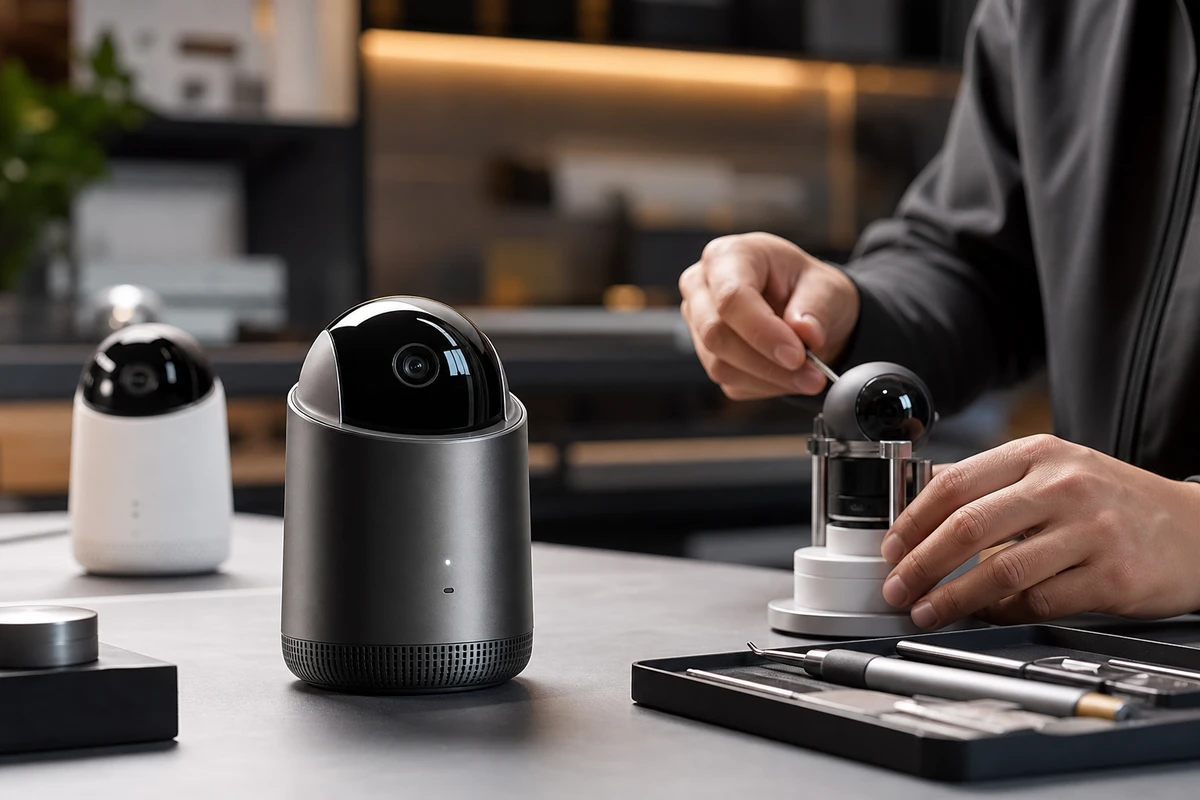
The first column of the execution sheet records prototype status: assign separate numbers to engineering samples, mass-production samples, and retail-packaged samples, and photograph and archive battery level, firmware, accessories, cosmetic defects, and removable parts item by item. The second column records who may operate the product: engineers own safety boundaries and parameter explanations, actors own natural use, and cinematographers only turn the actions into editable shot tasks. A common on-set situation is that the same prototype is filmed for structure in the morning, then receives a firmware upgrade that changes the interface in the afternoon, leaving subtitles inconsistent with the product page.
Therefore, separate “demonstrable” from “not promiseable” before filming. Claims involving battery life, connection distance, recognition accuracy, or safety protection must include test conditions. Editing, close-ups, and sound design must not package an unverified function as a certain result. TikTok Shop’s official Content Policy requires product information to remain consistent with the detail page; this rule should enter the script structure and subtitle table in advance.
Rewrite Functional Tests as Filmable Shot Tasks
Do not write “show the intelligent experience” in the Brief. Replace it with executable actions: show the device starting in the opening frame, hand operation in the second shot, status feedback in the third, and a return to the real usage setting in the fourth. For functions requiring stress tests, define the input, process, result, and failure boundary in advance. For functions requiring an App, prepare a clean test account and resettable demonstration data. What matters is not how many specifications fill the screen, but whether viewers understand within the first three seconds which problem the product is solving.
On set, the creative director first confirms the visual hammer, then determines lighting and framing: use rim light and close-ups for material texture, a stable camera and continuous action for interaction logic, and overhead or exploded views for complex structures. One master set can then become a 16:9 product-page explanation, a 9:16 feed cut, and a captioned overseas sales version, instead of becoming one non-reusable long film.
Shenzhen On-Site Collaboration: Studio Conditions Must Serve Functional Proof
A smart-hardware project does not necessarily need a large-scale set, but it needs a studio where reflections, noise, network, and power can be controlled. Before arrival, confirm tabletop dimensions, dark-scene conditions, router or phone pairing, spare batteries, accessory storage, and the engineer’s attendance time. If outdoor or home settings are required, add transitions, weather, and prototype protection to the call sheet. Shenzhen cross-border ecommerce is moving from exporting products toward taking brands overseas and placing manufacturing, independent stores, and global sales on one chain. Content teams should therefore plan one shoot as a sustainable asset base.
The editor recommends writing “on-site collaboration” as a responsibility table: the brand confirms selling points and prohibited expressions, the product manager confirms demonstration conditions, the camera team owns lighting, camera positions, and asset naming, and post-production owns the version matrix and subtitles. Waiting until equipment reaches the set to find power, revise the script, and source accessories is usually more expensive than adding half a day of rehearsal.
Divide the Same Shoot into Three Types of Cross-Border Version
The first is the Shopify product page: the main film explains structure, usage steps, and size, working with product media to help users understand function and volume. Shopify officially states that product media can include images, 3D models, and video and notes that the theme must support video display. Its Product Media Documentation can be used as a pre-upload checklist. The second is Amazon: preserve clear functional proof, subtitles, and safe areas, and prepare landscape and vertical outputs in advance. Amazon’s OLV Specifications list common durations, aspect ratios, encoding, and audio requirements. The third is TikTok Shop: show real people and physical products together in moving footage, avoiding an entire sequence of static images or product-page screenshots. Its High-Quality Video Requirements emphasize authentic environments, camera movement, and dynamic demonstration.
Media buyers care more about whether versions can enter the asset pool. For each function, preserve at least one opening-three-second hook, one complete demonstration, one result close-up, and one creator-asset interface. During editing, record names for masters, short cuts, landscape and vertical versions, multilingual subtitles, and source files so later A/B tests, remarketing, and channel handoffs do not require searching for assets again.
Acceptance Does Not Ask “Does It Look Like an Ad?” but Whether All Evidence Was Delivered
Divide delivery acceptance into five layers. At the image layer, check focus, reflections, opening frame, and safe areas. At the function layer, verify test conditions, action order, and wording of results. At the version layer, verify 16:9, 9:16, short cuts, subtitles, and covers. At the platform layer, check Shopify product-page, Amazon advertising, and TikTok Shop upload restrictions. At the asset layer, check masters, project files, fonts, music rights, and naming. Amazon Stores’ official creative specifications also list cover, resolution, and MP4/H.264 requirements for video tiles separately and can be placed directly into the acceptance table.
If you are comparing Shenzhen vendors, first prepare the prototype list, target platforms, functions that must be proven, prohibited expressions, and expected delivery versions, then see whether Shenzhen Video Production Services can translate them into scripts, storyboards, lighting, editing, and acceptance actions. If content assets and media versions need coordinated planning, also review the scope of Video Marketing Services.