When a client comes with a feature checklist to request a quote, a producer should first ask: which shots require on-road driving? Which details can be completed in-studio? If these two questions are not answered before budgeting, the first thing to go wrong on shoot day is often not the image, but vehicle scheduling, weather contingency, and whether a given feature can actually be proven.
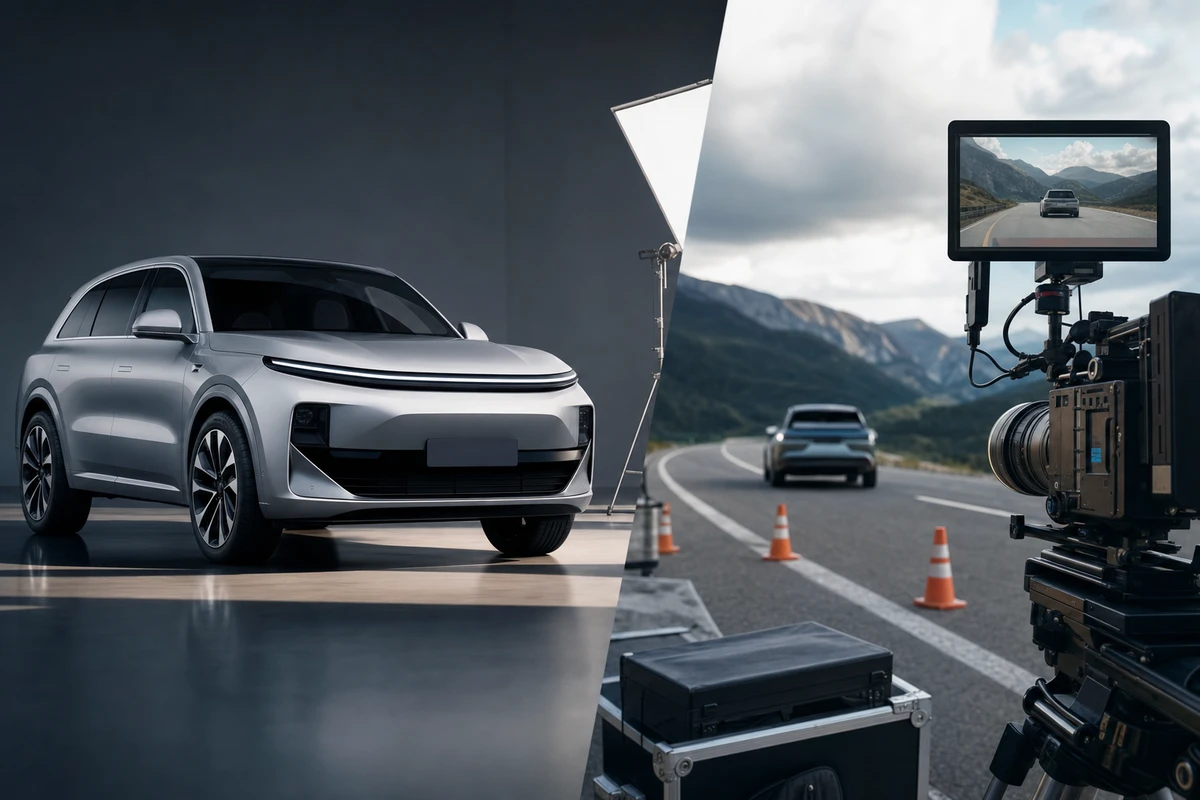
For automotive and mobility product video production planning, it is recommended to break down scenes by evidence first, then schedule by risk. The real concern is not road versus studio, but whether a scene can deliver the evidence: road scenes bear motion relationships, studio scenes bear controllable details, and feature demonstrations bear verifiable actions.
Turn the Feature Checklist into an Evidence Map First
Do not start pricing from "we need to shoot a premium car commercial." Instead, write each selling point as an action that can be seen, constrained, and verified:
| What the client wants to express | Preferred scene | Must be locked in advance | What it must not be substituted with |
|---|---|---|---|
| Ride quality, steering relationship, driver-vehicle distance | Road or closed course | Vehicle scheduling, camera positions, safety officer, alternative routes | Static studio shots must not be passed off as real motion evidence |
| Paint finish, lighting clusters, interior, structural details | Studio or controlled exterior | Cleaning, reflection control, lighting wrap, reusable close-ups | Excessive reflections must not obscure material details as "unclear" |
| A particular assistance or interaction feature | Feature demonstration area | Applicable conditions, demonstration actions, supporting documents, visual no-go zones, approver | Demonstration footage does not automatically equal a general performance claim |
ONCE's tool is the road-studio-feature evidence matrix. It makes the budget correspond to the delivery purpose.
What to Shoot on Road, What to Shoot in Studio
The most valuable aspect of road footage is motion relationships: how a vehicle enters frame, how speed sensation is established, how people, car, and environment relate. The most valuable aspect of studio footage is control: reflections, paint finish, lighting clusters, interiors, and mechanical actions can be repeated, adjusted, and reused across versions.
A practical rule of thumb: shots that require real road surface relationships go into the road plan; shots that need repeated retakes to pass review should go into a studio or closed course first. More exterior scenes do not automatically mean more realism—the key is which scene can deliver clearer evidence with less risk.
Commercial production bid materials typically require the quote to detail production methodology, assumptions, integrated footage, travel, equipment, DIT, post-production, and insurance, rather than submitting only a lump sum. Reference AICP's commercial production bid materials, but the contractual terms and ratios therein cannot be directly transplanted to local projects.
Feature-to-Shot Evidence Card: Do Not Let Demo Footage Cross into Fact
Each feature should have at least six columns: feature statement, visible action, applicable conditions, supporting documents, visual no-go zones, and final approver. For example, "automatic parking" must not only show a shot of the steering wheel turning by itself in a parking space, but also state the demonstration conditions, whether it is a controlled course, and which capabilities are not proven in this video.
This card separates "looking realistic on screen" from "being verifiable by sales, legal, or the product team." The set is responsible only for shooting the approved action clearly, not for supplementing performance conclusions on behalf of the product team; if applicable conditions and supporting documents are not in place, mark the shot as pending evidence, do not rely on voiceover to fill the gap.
The factual boundaries of vehicle safety and driving behavior must be based on the project's jurisdiction and the brand's already-approved materials. This article provides production triage guidance only, not road permits, insurance, stunt driving advice, or regulatory compliance opinions.
Four Pre-Shoot Gates for Road Shooting
A road plan should pass at least four gates before principal photography:
- Location gate: Shooting location, road condition, closed or open-road status, permit responsible person, and alternative location.
- Vehicle gate: Primary vehicle, backup vehicle, cleaning, charging or refueling, vehicle condition, driver, and dispatch sequence.
- Camera-position gate: Camera positions, personnel distance, evacuation routes, and communication methods needed for in-car, exterior, chase, follow, and wide shots respectively.
- Weather gate: Shootable weather, cancellation threshold, post-rain alternative shots, and which footage can be completed in-studio first.
Each item must specify "who confirms" and "when it freezes." Refer to the resource structure of Creative BC: exterior locations involve regional, service, and production conditions simultaneously.
Studio Is Not a Fallback—It Is an Evidence Control Room
If a feature requires repeated adjustment of lighting positions, vehicle angles, reflections, or interior states, the studio is often easier for verification than bringing all variables onto the road. The studio budget should specify the clean shooting area, vehicle access path, lift and cleaning conditions, lighting and reflection control, and whether text-free or reconfigurable footage must be retained after the shoot.
The challenge with automotive paint and glass is not "making the car bright," but letting the audience see the contour, material, and motion relationship. Plan a lighting pre-visualization based on evidence first, then decide on the equipment package; equipment names themselves are not image value.
Break a Single Shoot into Reusable Versions
List the main film, sales presentation, website landscape, social media portrait, subtitle-free master, and feature short films at the Brief stage. If the same footage will also serve overseas brands, TikTok, or cross-border e-commerce pages, retain subtitle-free versions and safe compositions in advance. For each version, specify aspect ratio, duration, audio state, footage dependencies, approver, and delivery date; post-production should not bear the full cost of discovering that the original footage lacks safe compositions.
Frame.io's post-production workflow resources break editing, color grading, production, cinematography, and review into different responsibilities, which corresponds directly to version handoffs in automotive projects: the director confirms expression, the cinematographer confirms footage conditions, the product team confirms features, the brand confirms tone, and post-production confirms the master and derived versions. Reference Frame.io Insider's production and post-production workflow entry, but final approval still follows the client's delivery schedule.
Add two more columns to the version reuse checklist: whether it can be cropped to portrait, and whether the feature needs to be re-proven. Croppable does not mean usable.
How to Evaluate Whether a Supplier Quote Is Complete
Break the quote into four layers: scenes and permits, vehicles and personnel, cinematography and lighting, post-production and versions. Each layer requires the supplier to state assumptions, inclusions, exclusions, alternatives, and conditions that trigger additions.
- Does the road line item specify vehicle scheduling, chase or follow methods, weather alternatives, and a safety officer?
- Does the studio line item specify vehicle access, cleaning, reflection control, lighting pre-visualization, and reusable close-ups?
- Does the feature line item specify applicable conditions, supporting documents, approver, and expressions that cannot be shown?
- Does the post-production line item specify master, landscape and portrait versions, subtitle-free version, feature short films, and review rounds?
If all four layers trace back to the evidence map, the brand understands "why the quote is structured this way"; if only shooting days, camera-position count, and a lump sum are provided, the items most likely to be cut are alternative routes, feature verification, and version reuse.
If you are preparing a video brief for automotive or mobility products, first submit the road-studio-feature evidence matrix, then let the production team determine which shots are worth real-world filming, which should go into the studio, and which features need evidence first. Learn about ONCE's TVC and advertising film production solutions, then submit your production requirements and receive a quotable automotive product video plan.