Project Assessment Criteria for Multi-Point Integration
Before launching a TVC project, marketing leads must confirm whether multiple selling points share a physical or logical symbiotic relationship. If points are only abstractly related without specific interaction scenarios, forced merging causes information overload and audience confusion. Assessment criteria should be based on the natural continuity of product usage rather than the order of a marketing checklist. When more than three features must appear in one shot, assess whether the action aligns with ergonomic or mechanical principles.
- Verify if a causal chain exists between selling points; for example, activating a safety lock while powering on the device is suitable for integration. If two functions correspond to different user roles or usage stages, they should be split into separate segments.
- Check the visual capacity of the core action; a continuous movement typically conveys only one or two key messages clearly. Exceeding this requires supplementary shots or extended duration, otherwise communication efficiency for all points will suffer.
- Confirm the cognitive load threshold of the target audience; professional users accept high-density technical demos, while mass consumers need more processing time. Use focus group testing during the project initiation phase to preliminarily validate information density.
If assessment shows points cannot merge naturally, adjust the creative direction promptly to avoid cutting core content or increasing budgets for reshoots during production. In such cases, a series of short films or interactive videos may be more effective than a single TVC.
Structured Materials Required from the Brand
Production teams cannot construct credible multi-point actions from scratch; brands must provide internally verified technical documentation and usage records. These materials form the foundation for script development and storyboarding; their absence leads to creatives that deviate from actual product capabilities. Submit materials before creative proposals, noting priorities and non-negotiable items.
- Provide complete product manuals or engineering drawings, specifically marking the physical location, trigger conditions, and linkage mechanisms of each functional module. Text descriptions must be accompanied by test videos showing hand trajectories, force feedback, and timing in real-world operation.
- List compliance statements and prohibited expressions for each selling point, clarifying which demonstration methods may cause legal risks or user misunderstanding. For instance, certain safety features activate only under specific conditions and must not be simplified in advertising.
- Submit breakdown analyses of similar competitor ads, highlighting successful integration techniques or cognitive pitfalls in failed cases. This helps the production team avoid industry clichés and establish differentiated expression.
If the brand provides only marketing copy without technical support, the production team should pause creative development and request empirical data. Otherwise, subsequent filming may require rework due to incorrect props, unrealistic actions, or failed legal review, causing delays and cost overruns.
Visual Pre-visualization Methods for Action Design
Embedding multiple selling points into a single action requires precise spatiotemporal arrangement that text scripts alone cannot verify. Dynamic pre-visualization must be completed before principal photography to test information flow, visual focus accuracy, and pacing against audience attention curves. Pre-vis results should serve as the sole reference benchmark for execution.
- Create detailed storyboards with timecodes, annotating each frame with the current selling point ID, actor action nodes, camera parameters, and audio cues. Ensure only one dominant message exists at any moment, keeping secondary information in the background or transition state.
- Build simple practical sets or use 3D preview software to simulate key action sequences, inviting non-project personnel to view and record their immediate reactions. If viewers cannot identify the intended number of selling points without narration, redesign the action logic or split the shots.
- Review action safety and authenticity with stunt coordinators or product engineers to eliminate designs that violate product principles for visual effect. For example, when rotating to showcase multi-function ports, ensure cables do not tangle or obscure labels.
Modification costs during pre-visualization are far lower than on-set adjustments. Skipping this step risks unusable footage due to disjointed actions, missing points, or continuity errors. Production teams should include the pre-vis report as a contract appendix and acceptance criterion.
Key Execution Controls On Set
Multi-point integration shots demand extreme on-set precision; minor deviations break the information chain. Directing, cinematography, performance, and technical departments must coordinate under unified commands, establishing standardized checks to ensure every take meets post-production needs.
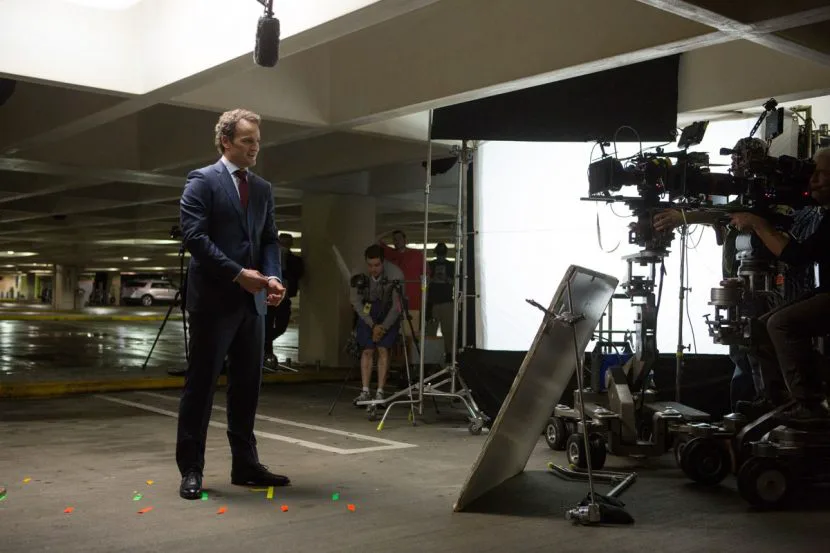
- Shoot using segmented markers; even for continuous actions, place hidden marks at selling point transitions. Actors must hold stable poses at each mark for at least two seconds to provide editing cut points. Cinematographers must simultaneously adjust focus or framing to ensure clear imaging windows for each point.
- Assign dedicated staff to monitor visual information completeness in real-time against the pre-vis storyboard. Stop and reshoot immediately upon finding missing or unclear points; do not rely on post-production fixes. Monitors should be technicians familiar with product features, not just the director's subjective judgment.
- Record multi-angle backup footage, including close-ups, wide shots, and slow-motion versions. Backup angles maintain narrative continuity if the master shot fails due to lighting or performance issues. Sync slate markers for all backup footage with the master to prevent post-production confusion.
Loss of on-set control typically results in incomplete point presentation or broken pacing, forcing heavy CGI fixes or voiceover explanations that diminish the TVC's native quality. Producers should review daily footage before wrap and have brand representatives sign off on key shots.
Post-Production Information Reinforcement Strategies
Even with perfect execution, post-production requires audiovisual fine-tuning to solidify multi-point delivery. Editing, color grading, sound, and graphics must serve the information hierarchy rather than pure aesthetics. Every frame must address the core question: 'Can the audience understand this selling point right now?'
- Editing rhythm must strictly follow pre-vis timecodes; never compress key action duration to match music beats. If footage is too short, insert product detail B-roll instead of speeding up playback to avoid distorting actions and reducing credibility.
- Use color and lighting to guide visual focus, enhancing contrast in the subject area during selling point transitions while minimizing background distraction. Test color grading during the rough cut to ensure consistent information legibility across display devices.
- Design a precise audio cue system, matching unique sound effects or voice tags to each selling point trigger. Audio intensity should correlate with visual importance, preventing background music from masking key auditory cues. Test mix clarity across various playback environments.
The risk of excessive post-processing is obscuring true product characteristics, such as using VFX to fake non-existent smoothness. All enhancements must be supported by original footage and noted in delivery documentation. Brand reviews should prioritize information accuracy over artistic expression.
Tiered Acceptance Checklist for Final Delivery
TVC acceptance cannot rely solely on overall impression; a quantifiable tiered verification mechanism is required. Each selling point must be tested as an independent unit to ensure integrated actions haven't diluted any function's communication efficacy. Acceptance results directly affect final payment and copyright ownership; document all party opinions in writing.
- Information Integrity Check: Compare the final video frame-by-frame against the approved storyboard to confirm all preset selling points are presented unambiguously. Missing items must be redone within a set timeframe; exemption based on 'good overall effect' is not permitted.
- Technical Specification Check: Verify resolution, bitrate, color space, and other parameters meet the latest platform requirements. For multi-version delivery, test landscape/portrait adaptability, subtitle safe areas, and audio-video sync accuracy separately.
- Compliance and Copyright Check: Confirm all product demonstrations comply with regulations and third-party asset licenses cover intended distribution channels. Source file handover lists must include project files, raw footage, and license proofs to prevent future modification blocks.
If acceptance reveals that point integration has blurred core messages, activate contingency plans rather than forcing release. This may involve partial re-editing, voiceover replacement, or reshoots; responsibilities and costs must be predefined in the contract. Acceptance sign-off constitutes approval of the current version's communication efficacy; subsequent changes are treated as new requests.
Applicable Boundaries of Multi-Point Integration Strategy
Not all products or communication goals suit multi-point integration. Blindly pursuing information density can backfire; production teams must identify unsuitable scenarios during initiation and propose alternatives. Use this strategy cautiously or avoid it entirely in the following situations.
- When product functions are highly specialized and the audience is niche, integrated actions may be perceived as superficial performance. Such projects suit in-depth explainer videos or interactive demos better, allowing users to control information intake pace.
- When selling points inherently contradict or involve trade-offs, forced integration exposes product flaws. For example, emphasizing extreme thinness while showcasing superior heat dissipation is physically inconsistent; honestly explain design trade-offs rather than concealing them.
- When platforms favor fragmented consumption, long-form integrated actions suffer low completion rates. Social media shorts should adopt a single-point focus strategy, with the TVC serving as a full-version traffic driver rather than an information dump.
Identifying boundaries ensures resources target the most effective expression. When multi-point integration risks are too high, ONCE offers campaign video packages, achieving goals through coordinated multi-content strategies rather than betting on a single high-risk piece.
Recommended Next Steps
If you are preparing a TVC project and face challenges integrating multiple selling points, we recommend first organizing product technical documentation and user usage records to complete an internal assessment of selling point relevance. You may then contact the ONCE team for a creative feasibility consultation; based on the materials provided, we will determine whether this strategy is applicable and offer targeted execution recommendations. Please note that specific plans must be developed by considering product characteristics, budget cycles, and media schedules; the methods described herein serve only as a general framework reference.
If you are preparing a TVC project, start by organizing the brief, visual references, product or company materials, delivery platforms, and licensing scope before reviewingthe TVC Services pageto translate abstract preferences into actionable production parameters.