The Necessity of Assessing Perspective Consistency During Project Initiation
Before launching an AIGC commercial project, brands must clarify the alignment between core selling points and visual presentation. Many projects fail because the spatial relationship between live-action footage and generated content is not confirmed early on. If a product must be placed in a complex environment, existing assets must be evaluated for sufficient geometric information for AI inference. Teams should check horizon line positions, vanishing point distributions, and lens focal length characteristics in reference images. Lacking this foundational data causes floating effects or scale discrepancies during post-production compositing. Instead of forcing a full AI generation solution, a hybrid production workflow should be considered. Decision-makers must confirm whether communication goals allow for stylized abstraction; if extreme photorealism is required, original shooting precision standards must be raised.
Geometric Reference Materials Required from Brands
To ensure AI accurately understands scene structure, brands must provide reference materials containing clear perspective cues. These include ground photos with grid lines, images of objects with known dimensions, and multi-angle 3D scan data or high-precision models of the product. Providing only solid-color backgrounds or featureless planes fails to supply depth information to algorithms. Teams should compile a list including lens parameters, shooting heights, and angles; even if generative tools later replace backgrounds, this metadata is key to constraining results. If 3D models are unavailable, orthographic product line drawings are the minimum requirement. Missing such materials forces extensive manual corrections by the post-production team, increasing budget overrun risks.
Camera Height Control During Shooting Execution
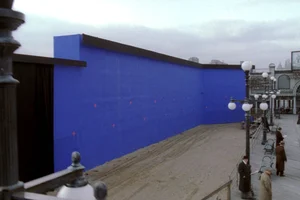
Camera height and lens focal length must be strictly locked during live-action shooting. Using a tripod is recommended to avoid minor shakes from handheld shooting, as AI easily produces jitter artifacts when processing dynamic perspective. Cinematographers must record sensor size, focal length values, and lens distortion characteristics for every shot. If background replacement is planned, foreground object edges require sufficient green screen or clean background space for algorithmic subject separation. Lighting setups should simulate target environment light directions to ensure shadow projection angles match the generated background. If on-site conditions are limited, inform the post-production team in advance to adjust lighting logic during generation. Neglecting these details causes lighting conflicts between composited products and backgrounds, destroying realism.
Staffing and Collaboration Workflow Standards
Efficient project execution relies on clear role division. Pre-production planners define visual styles and collect perspective reference data to ensure creative concepts are technically feasible. Directors must collaborate closely with cinematographers to strictly execute established camera parameter settings and monitor perspective lines in real-time. Post-production compositors need 3D spatial thinking to interpret camera intrinsic data and translate it into constraints for generative tools. Project managers must coordinate deliverables across stages to ensure accurate metadata transfer from live-action footage to generated layers. Communication gaps at any stage can cause perspective baseline shifts, making standardized file naming and data handover protocols essential.
Perspective Correction Actions in Post-Production
Upon entering post-production, the primary task is establishing a 3D proxy model of the scene. Use photogrammetry or manual modeling to reconstruct the shooting environment's geometry as a constraint framework for AI generation. Generative imagery tools require camera intrinsic and extrinsic data to ensure generated textures and objects follow physical perspective laws. Teams must inspect edge alignment of generated content frame-by-frame, especially ground contact shadows. If perspective deviations occur, adjust camera angle descriptions in generation prompts or use traditional CGI methods for local corrections. Directly overlaying unmatched generated layers is strictly prohibited at this stage to prevent obvious visual discontinuities. Every correction must be versioned to trace issue sources.
Visual Consistency Standards for Final Delivery Acceptance
Acceptance checks must focus on product-environment interaction logic. Verify natural contact shadows beneath products and ensure reflection highlights match environmental light distribution. Zoom in to inspect edge pixels for aliasing or abnormal blur transitions. In dynamic shots, product motion trajectories must synchronize with background perspective changes without sliding or drifting. Sound design must also align with visual perspective; nearby objects should sound clear and full, while distant background audio attenuates accordingly. Subtitle layouts must not obscure key perspective cues like horizons or vanishing points. All deliverables must include layered source files for future adjustments. Multiple perspective errors warrant rejection and rework rather than simple patching.
Applicable Boundaries and Exceptions for AIGC Solutions
Not all product videos suit AI-composited perspective solutions. Current generative tools struggle to accurately simulate complex refraction and reflection for materials like highly reflective metals or transparent glass, often causing noise or logical errors. For brands requiring extreme physical accuracy, such as medical devices or precision instruments, traditional CGI rendering is recommended. Additionally, fast-iterating social media short videos may tolerate minor perspective flaws for efficiency, but TVCs must strictly adhere to optical principles. When scenes involve numerous dynamic human-product interactions, AI stability in handling limb occlusion is insufficient and requires careful evaluation. Projects exceeding technical boundaries should shift to hybrid or pure live-action production early.
Risk Management and Recommended Next Steps
Teams should first test a single static scene to verify the match between camera parameters and generation results. Expand to dynamic shots or complex environments only after confirming workflow stability. Brands and production teams should jointly develop detailed perspective verification checklists and incorporate them into contract acceptance clauses. Stay updated on generative imagery technology advancements to adjust production strategies promptly. If existing assets fail perspective requirements, decisively conduct supplementary shooting or 3D data capture to avoid uncontrolled post-production costs caused by early compromises. Balance technical capabilities with creative needs rationally to ensure final videos align with brand tone and possess visual persuasiveness. Establishing standardized perspective matching workflows effectively reduces rework rates and improves AIGC commercial production efficiency and quality stability.

If preparing an AIGC commercial project, organize your brief, reference images, product or corporate materials, delivery platforms, and copyright scope before reviewing theAIGC Video Services Pageto translate abstract preferences into actionable production boundaries.