How to Define Commercial Standards for Shot Stability During Project Initiation
When preparing an AIGC commercial project, brands often simply equate flicker-free footage or non-deforming objects with shot stability, a misconception that can easily lead to acceptance disputes. Stability in commercial video is a composite metric encompassing three dimensions: temporal continuity, spatial consistency, and semantic accuracy. Temporal continuity refers to the smooth transition of lighting and textures between adjacent frames, spatial consistency requires that perspective and physical laws meet audience expectations, and semantic accuracy ensures that product appearance and brand identifiers remain recognizable during motion. Project initiation documents must translate these three dimensions into specific acceptance descriptions, avoiding subjective terminology.
When evaluating different generative models, judgments should not be based solely on the quality of a single static image. The production team should be required to provide test clips of at least five continuous seconds using the same prompt and reference image, with a focus on observing visual performance during significant motion. If the project involves real product placement, additional testing is needed to evaluate the model's ability to reproduce specific geometric structures and material reflections. Some models excel at generating artistic atmospheres but fail to maintain product details, while others offer structural stability but lack lighting and textural quality. Brands must confirm during the initiation phase whether the core objective is emotional conveyance or information display, and set stability weight priorities accordingly.
The risk lies in over-pursuing technical parameters at the expense of narrative efficiency. While some highly stable models produce smooth footage, their camera pacing is often rigid and fails to match the editing rhythm of a commercial. It is recommended to screen dynamic test reels from different models at the kickoff meeting, with the director, editor, and brand representatives scoring them jointly, rather than relying solely on parameter reports from the technical team. If test results show that no candidate model meets the product fidelity requirements, the plan should be decisively adjusted to a traditional shoot with post-production enhancement, avoiding budget waste on the wrong path.
Structured Visual Asset Checklist Required from the Brand
The stability of AIGC video relies heavily on the quality and structure of the input assets. Brands cannot simply provide a few product photos and expect perfect dynamic footage. They must prepare high-resolution product images from front, side, top, and bottom angles, orthographic views with dimension annotations, material close-ups, and usage scenario photos in real environments. These assets will serve as image prompts or ControlNet constraints, directly determining the anchor point density of the generated frames. When key angle assets are missing, the model will hallucinate the structure, leading to continuity errors or deformation in rotating shots.
In addition to product materials, a clear visual mood board and a list of negative prompts must be provided. The mood board should include color ranges, lighting directions, depth-of-field preferences, and reference film frames to unify the tone across different generation batches. Negative prompts must list absolutely prohibited elements, such as competitor features, incorrect logo variants, or non-compliant visual symbols. These materials should undergo internal review before project launch to ensure there are no objections from the legal and marketing departments. Ad hoc additions or modifications to reference materials will invalidate already generated clips, severely delaying progress and increasing costs.
Pay special attention to the completeness of copyright and licensing documents. If third-party stock assets are used for style guidance or texture overlay, their commercial licenses must explicitly cover AI-generated derivative works. Brand-owned assets must also be verified for portrait rights, location rights, and design copyright ownership. Inputting unverified assets can lead to the final video being taken down or even legal risks. It is recommended to implement a sign-off process during asset handover to clearly define each party's liability regarding asset compliance. If assets are missing or questionable, the production team has the right to suspend the generation of related shots until the issue is resolved.
Stability Integration in Hybrid Live-Action and Generative Workflows
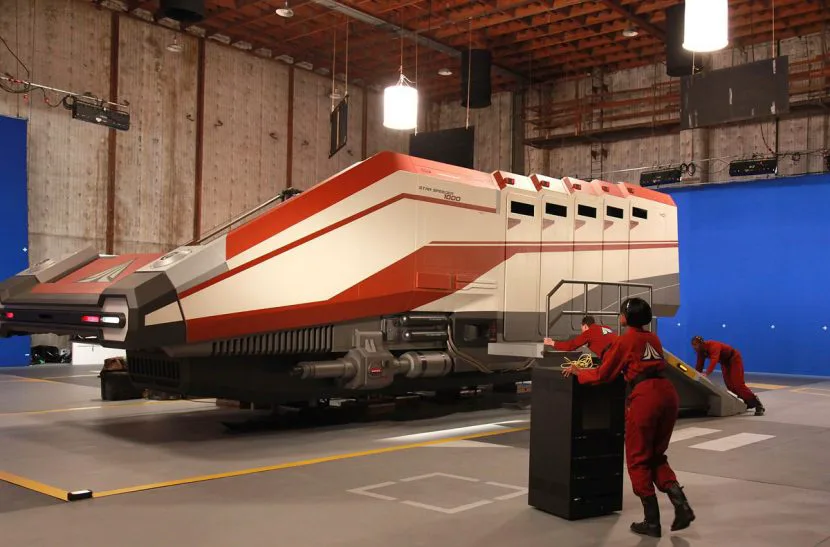
A purely AIGC workflow struggles to guarantee full-video stability, so commercial projects typically adopt a hybrid live-action and generative workflow. The live-action portion handles product displays, actor performances, and base frames for key actions, while the AIGC portion manages background extensions, stylization, or surreal transitions. The key to integrating the two is reserving the redundant information needed for AI processing during the initial shoot. For example, green screen keying must retain sufficient edge feathering, motion tracking markers must avoid areas slated for later replacement, and lighting setups must account for matching the light sources of the generated backgrounds.
During on-set execution, dedicated personnel must record the camera parameters, focal length, aperture, and motion trajectory data for every live-action take. This information is essential for the AI to understand the real physical space in post-production. If shooting handheld or with a gimbal, gyroscope data should be recorded simultaneously or motion metadata exported for later reprojection. Neglecting this data collection will cause a disconnect between the generated content and live-action footage in terms of perspective, motion blur, or depth of field; even if each looks fine individually, the composite will appear jarring.
An exception applies when live-action conditions are too restricted to capture ideal footage, in which case generating a base layer entirely via AIGC and repairing it with traditional post-production can be considered. However, this requires greater computing power, longer iteration cycles, and yields a lower quality ceiling than the hybrid workflow. The decision hinges on comparing the break-even point between reshoot costs and AI repair costs. If a half-day reshoot can solve the stability issue, it should not be forcibly replaced by three days of AI rendering. After location scouting, the production team should promptly provide cost and quality estimates for both paths, allowing the brand to make a rational choice based on actual resources.
Layered Repair Strategies for Stability in Post-Production
Once AIGC assets enter post-production, stability fixes should be handled in prioritized tiers. The first tier is global temporal consistency correction, using optical flow interpolation or temporal diffusion models to eliminate overall flickering and jitter. This step must be completed before color grading and compositing, otherwise subsequent adjustments will amplify the original defects. The second tier is local semantic correction, using mask repainting or replacement to address product distortion, garbled text, or limb anomalies. The third tier is motion smoothing, applying digital stabilization or refitting curves to camera trajectories to ensure camera movement aligns with professional cinematography logic.
A version control mechanism must be established during the repair process. Every parameter adjustment should be saved as an independent project file and output sample to avoid introducing new artificial artifacts through over-correction. For example, aggressive temporal smoothing can cause motion blur on moving objects, and local repainting can result in harsh edge blending. Editors and VFX artists must repeatedly compare pre- and post-repair effects, reverting to the previous version to retry if necessary. Overwriting the original generated results without a backup is strictly prohibited, as this eliminates the possibility of backtracking and comparison.
Sound design has an implicit impact on visual stability. When the image has minor flaws, precisely matched sound effects and ambient audio can divert the audience's attention and enhance the overall perceived quality. Conversely, audio-visual desynchronization will amplify the sense of visual instability. Therefore, audio production should proceed in parallel with visual repair rather than waiting until the picture lock. If a shot remains unsatisfactory after multiple repair attempts, consider bypassing it through editing rhythm, such as shortening the shot duration, inserting a cutaway, or covering it with voiceover. Acknowledging the limitations of AI and compensating with creative techniques aligns better with commercial delivery logic than obsessing over technical fixes.
Multi-Dimensional Acceptance Checklist for Shot Stability
Accepting the shot stability of an AIGC commercial requires more than just reviewing the final cut; it must be broken down and verified step by step. During the script and storyboard phases, the feasibility descriptions for each AI-generated shot must be reviewed for specificity to avoid vague instructions causing post-production rework. During the production phase, live-action footage must be verified to meet the technical requirements for AI integration, and unqualified footage should be reshot on the spot. The rough cut phase focuses on checking the spatiotemporal continuity at shot transitions, while the fine cut phase confirms the dynamic accuracy of product and brand elements. The color grading and VFX phases evaluate whether repair artifacts are within acceptable limits, and the final mix phase verifies the supportive effect of audio-visual synchronization on stability.
Every acceptance stage should have written records and signed confirmations. When issues are found, responsibility and solution deadlines must be clearly defined to avoid memory discrepancies caused by verbal communication. For highly subjective perceptions of stability, A/B testing is recommended, allowing multiple stakeholders to blindly evaluate different versions and adopting the consensus rather than individual preferences. If disagreements are too great, decisions should be based on the objective standards agreed upon at project initiation rather than endlessly adding revision rounds.
In addition to the final master, deliverables should include generation parameter logs for key shots, repair process documentation, and archived source files. These materials serve not only as acceptance credentials for the current project but also as reusable knowledge assets for future series content production. Delivering without process documentation means handing over stability control entirely to a black box, which will lead to repeated trial and error when changing teams or models in the future. Brands should list documentation completeness as a prerequisite for payment to enforce the standardization of the production workflow.
Applicable Boundaries and Risk Warnings for AIGC Video Production
AIGC is not a universal panacea and has clear applicable boundaries. When a project has strict requirements for product precision, authentic human performance, or complex interactions, traditional production remains the preferred choice. For example, in medical device operation demonstrations, automotive crash tests, or close-ups of food being eaten, AI currently struggles to guarantee zero-error physical credibility. Forcing its use may lead to compliance risks or consumer trust crises. Brands need to honestly evaluate the nature of the content at the project's outset and avoid being swept up by technological hype.
Copyright and legal risks represent another major boundary. The determination of copyright for AI-generated content is still evolving across different countries, and commercial projects require advance consultation with legal counsel. If a project involves global distribution, special regulations in target markets must be closely monitored. Some platforms have mandatory labeling requirements for AI content, and non-compliance may result in traffic restrictions or removal. Production teams should proactively inform clients of relevant risks and provide compliance advice rather than assuming the brand is already aware. The consequences of concealing risks far exceed the production costs themselves.
Timeliness and controllability are also important considerations. The randomness of AIGC means that achieving satisfactory results may require extensive iteration, leading to far greater schedule fluctuations than traditional production. If a project has a fixed launch date, you should build in ample buffer time or prepare a live-action backup plan. Treating AIGC as a value-added option rather than the sole dependency allows you to reap the technological benefits while safeguarding your commercial baseline. Be wary of any vendor promising 100% stability or unlimited revisions, as this contradicts current technological realities.
Recommended Next Steps
If you are evaluating the feasibility of AIGC commercials or AI product videos, we recommend first organizing your existing visual assets and core communication goals, then conducting a small-scale test with a team experienced in hybrid production. ONCE provides professional services spanning AIGC video production, brand promotional videos, and overseas marketing videos, assisting you through the entire process from project evaluation to final delivery. Please visit our website to explore our services and submit a project brief, and we will provide practical, tailored recommendations based on your specific needs rather than vague technological promises.
If you are preparing an AIGC commercial project, you can first organize the brief, reference visuals, product or company materials, delivery platforms, and copyright scope, and then review theAIGC Video Services pageto translate abstract preferences into actionable production boundaries.