Treat children and pets as special talent during the pre-production stage.
Children and pets in TVC commercials can quickly build emotional connections, but the risks also concentrate on these two subjects. Children's behavior is uncontrollable, and pets' reactions are even harder to predict—any accident will directly drive up shooting costs and affect delivery schedules. When launching the project, the brand and production team should jointly confirm three basic questions.
First, whether children and pets serve as the lead or supporting element in the script. If they are the lead, reserve more rehearsal and shooting time and prepare alternatives. If they are a supporting element, consider using close-ups, back views, or post-production compositing to reduce on-set control difficulty.
Second, clarify guardian-accompaniment conditions. Children on camera must be accompanied by a parent or legal guardian throughout the shoot and must sign a written consent form. Pets on camera require the owner or a professional trainer to be present, and vaccination records and health certificates must be provided. These documents must be filed at the project kickoff, not patched together the day before filming.
Third, assess location risks. Areas where children and pets will move should be inspected in advance to remove sharp objects, fragile decorations, electrical cords, and small swallowable items. If the location has pools, stairs, or glass curtain walls, add protective measures or adjust camera positions.
The risk criterion is that any element that could injure a child or pet must be revised at the script stage, not handled on the fly at the shoot. If the script cannot be revised, consider using CGI or AIGC to generate replacement footage, but budget and realism must be additionally evaluated.
Scripts and storyboards should preset safety boundaries and alternative shots.
The script stage should define safe action ranges for children and pets. Children's movements should be simple and clear, avoiding running, climbing, or vigorous interaction with props. Pet actions should match their nature; do not force performances, such as making cats jump or dogs stay still for long periods.
During the storyboard phase, list the safety requirements for each shot. For example, when children and pets appear in the same frame, keep them at least one arm's length apart to avoid startling the pet and causing scratches. For solo pet shots, use a telephoto lens to shoot from a distance, reducing stress caused by crew members approaching.
Also prepare a list of alternative shots. If a child cries or a pet refuses to cooperate, the set can switch to alternative shots, such as filming only the hands, feet, or back, or using cutaway shots with voice-over transitions. Alternative shots should be clearly marked in the storyboard so the team isn't caught off guard when shooting is interrupted.
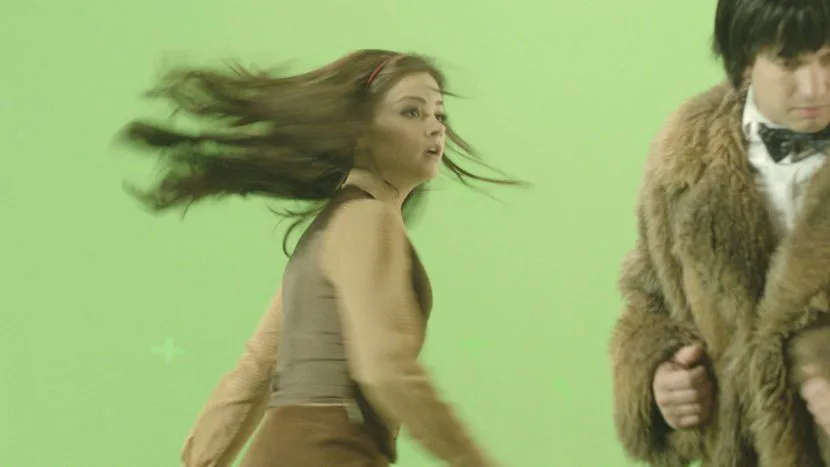
If CGI is planned to replace certain actions of pets or children, the script must clearly state which shots are filmed in-camera and which are generated in post. The in-camera portions should be kept as simple as possible, providing only motion reference and lighting material, with the full image composited later. This reduces on-set risk, but the match between CGI and live-action footage must be tested in advance.
The standard is that every shot should have at least two versions: an ideal version and a safe version. The safe version should not require extra cost, but it should ensure that production stays on schedule. If even the safe version cannot be achieved, consider removing the shot or adjusting the creative direction.
On-Set Safety Control and Communication Workflow
On the shoot day, the production team must designate a safety coordinator responsible for monitoring the condition of children and pets. The safety coordinator does not participate in the actual filming, focusing only on the subjects' behavior and emotional changes, and has the authority to pause shooting.
For child shoots, each continuous working session must be controlled, with a 15-minute break after every 30 minutes of filming, during which water, snacks, and a quiet area are provided. For pet shoots, a 10-minute break is required after every 20 minutes of filming, allowing pets to leave the shooting area and move freely. Break time must be included in the shooting schedule and cannot be shortened.
Clear instructions must be used for on-set communication. For children, the director should describe actions in simple language, such as 'walk slowly to the table,' avoiding abstract commands. For pets, the handler should use verbal cues or hand signals, while other personnel remain quiet and do not approach the pet casually.
Special attention must be paid to lighting and sound effects. Children are sensitive to strong light and sudden noises, while pets are sensitive to camera flashes and high-frequency sounds. The lighting team should use softboxes and low-light solutions, and the sound team should avoid whistles or sharp sound effects. If smoke or dry ice is used, it must be non-irritating and the area must be well-ventilated.
The risk warning mechanism is as follows: when the safety coordinator notices signs of fatigue, stress, or discomfort in a child or pet, they immediately notify the director to pause. After pausing, the guardian or handler evaluates whether to continue; the director cannot decide unilaterally. If the pause exceeds 30 minutes, an alternative shot plan must be activated.
After filming, children and pets should leave the set first before striking it. Before leaving, confirm that no personal items are left behind, and record the shot numbers involving children and pets from that day's footage to facilitate later review.
Post-production editing should prioritize safety-related footage.
During post-production editing, first review all footage involving children and pets, and flag any potentially controversial shots. Examples include children showing painful expressions, pets being forced to perform actions, or unsafe props appearing on screen.
The editing principle is that shots of children and pets should be natural and authentic, but must not reinforce dangerous behavior. For example, a shot of a child running should be cut or replaced if the ground shows wet or slippery marks. A shot of a pet jumping should also be adjusted if the height exceeds the animal's ability.
If CGI or AIGC is used to generate images of children or pets, ensure the movements are smooth and physically plausible. Children's facial expressions should be natural, and pet fur and muscle movement should be realistic; otherwise, it may cause viewer discomfort. The post-production team should prepare test renders and confirm the results before finalizing the cut.
Audio processing is also important. Children's laughter and pet sounds should use location audio or high-quality assets; avoid canned sound effects. If location audio is unclear, re-record or use assets from the same batch; do not mix sounds from different environments.
Descriptions involving children or pets in subtitles and narration must be accurate and must not exaggerate or mislead. For example, "children playing happily" must be supported by the visuals; if the shot only shows a back view, it should be changed to "children playing at home".
Before delivery, produce a safety-review version for internal review. This version should mark each shot's timecode and risk notes to help legal or brand teams check quickly.
The acceptance checklist should cover special items for children and pets.
During final review, in addition to standard image quality, audio, and editing pace, add special inspection items for children and pets. Checklist items should specify individual shots, not simply state "no risky content".
First, confirm that all shots featuring children and pets have written releases, and that the release scope covers the final film, behind-the-scenes footage, and social media distribution. If the release is limited to television, it cannot be used online.
Second, check whether the footage contains any details that could be interpreted as abuse or neglect. Examples include a pet collar that is too tight, a child’s clothing that is soaked, or a child alone in a dangerous area. Even if unintended, these details must be modified or removed.
Third, verify that CGI or AIGC-generated characters are sufficiently distinct from real people or pets. If viewers might mistake them for real, include a note at the end of the film or in subtitles stating that the footage has been post-processed to avoid misleading the audience.
Fourth, check whether the audio contains any sounds of children or pets in distress. If so, verify that the corresponding visuals are reasonable; if not, replace them. For example, a pet’s vocalization may indicate excitement, but if the visual shows the pet being pulled, it must be adjusted.
Fifth, confirm that all versions—television, online, and social media—use the same safety review standards. Do not skip checks simply because the online version is shorter.
Acceptance records should be detailed, including the timecode, inspection results, and correction actions for each version. If a revised version is redelivered, it must be checked again; do not inspect only the modified parts.
Inapplicable Scenarios and Alternative Solutions
Having children and pets on camera is not appropriate for every TVC commercial. In the following situations, we recommend avoiding them or using other expressive approaches.
If the product's target audience is adults and the ad needs to convey professional or serious information, children and pets may distract viewers. For example, for financial products or medical devices, using cartoon characters or abstract graphics is more appropriate.
If the shooting schedule is extremely short—for example, only two days—and the script requires extensive interaction between children and pets, the risk is too high. In this case, reduce the number of shots with children and pets, or replace them with still photos plus animation effects.
If the filming location is an outdoor open area such as a street or park, there are too many uncontrollable factors. Children and pets are prone to getting lost or being disturbed by external factors; we recommend using a closed studio or applying for location control in advance.
If the budget is limited and you cannot hire a professional animal trainer or child actor agent, we recommend using CGI or AIGC to generate the characters. However, you need to evaluate whether the generated result matches the brand tone and the cost of post-production revisions.
If the brand side cannot provide complete authorization documents or health certificates, the production team has the right to refuse filming. This is a legal bottom line and cannot be compromised for creative needs.
Recommended Next Steps
Before launching a TVC commercial project, we recommend that the brand side and production team conduct a risk rehearsal. The rehearsal content includes script safety review, location risk checklist, authorization document templates, and alternative shot plans. The rehearsal does not require actual filming; it only needs to be checked item by item in the conference room.
If a risk that cannot be resolved is discovered during the previs, adjust the creative direction in time or consider using AIGC generation. The services publicly listed on the ONCE website include TVC commercials and AIGC video production, providing you with end-to-end support from creative to delivery. For specific cooperation details, please communicate with the ONCE team based on project needs.
If you are preparing a TVC commercial project, you can start by organizing the brief, reference images, product or company materials, delivery platforms, and copyright scope, then visitthe TVC Commercial Service page, moving communication from abstract preferences to executable production boundaries.