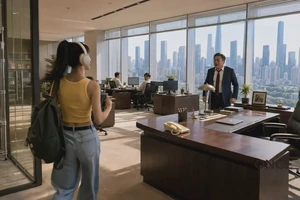
Can virtual production be used directly for core shots in commercials?
When evaluating virtual production technology, many production teams often focus on screen size or rendering precision, yet overlook the optical limitations in actual shooting. Unreal Engine's In-Camera VFX technology is not a universal solution; it relies on LED display, real-time rendering, and camera tracking systems to make the virtual background change with the real camera's perspective. For commercials and short films, the primary question is determining which shots are suitable for this technology. If a shot involves complex light and shadow interactions or extreme close-ups, the physical characteristics of the LED screen may become a bottleneck. Therefore, in the pre-production stage, the range of applicable shots must be clarified to avoid unfixable visual flaws in post-production.
Functional division between the inner frustum and outer frustum
Understanding the difference between the inner frustum and outer frustum is the foundation for developing a shooting strategy. The inner frustum can display a background that matches the camera's perspective, ensuring the image seen by the audience has correct perspective relationships. The outer frustum can still provide ambient light and reflections, offering real lighting feedback for actors and props. This division of labor means that even if certain angles cannot be fully completed through in-camera compositing, they can be handled by switching to a green screen only within the camera's field of view while retaining the outer frustum lighting. This hybrid mode ensures visual authenticity while improving production flexibility.
Key details of camera tracking and calibration
Live Link can receive camera, lighting, and transform data, but the accuracy of the data depends on preliminary calibration work. Camera calibration must match the position, orientation, and distortion of the real lens. Any minor deviation may cause misalignment between the virtual background and the live-action foreground. Additionally, an LED studio requires a master clock, a protected high-throughput LAN, render nodes, and monitoring links; screen size alone is not enough. A stable network environment and synchronization mechanism are prerequisites for ensuring multi-node rendering consistency; otherwise, screen tearing or latency will occur, severely impacting the shooting schedule.
Hardware Configuration and Network Architecture Requirements
nDisplay distributes the scene to the display cluster, which requires robust hardware support. The performance of the render nodes directly determines the frame rate and resolution of the image. The quality of the monitoring link affects the judgment of the director and cinematographer. If network bandwidth is insufficient or clocks are out of sync, it may cause image stuttering or color inconsistency. Therefore, when building a virtual production environment, the stability of the infrastructure must be prioritized, rather than merely pursuing the visual effects of the screen.
Pixel Pitch and Moiré Risk Control
Screen pixel pitch, camera sensor, shooting distance, and angle will affect moiré and visible pixels. This is one of the most common technical issues in virtual production. When the camera is close to the LED wall or the focal length is short, the pixels may become clearly visible, breaking the immersion of the image. Lens tests must be done before official shooting to find the optimal combination of shooting distance and angle. By adjusting the focal length and aperture, the moiré phenomenon can be mitigated to a certain extent, but it cannot be completely eliminated. Therefore, pre-production testing is crucial.
Collaboration Workflow Between Art Team and On-Set Team
Epic's best practices emphasize that the art team and the on-set team should conduct performance tests together. A scene on a workstation does not equal stable operation on an LED wall. This means that art assets performing well in offline rendering may cause frame rate drops in a real-time engine due to insufficient optimization. Both parties need to jointly establish a performance budget to ensure the scene runs smoothly on the target hardware. This collaboration is not limited to the technical level, but also involves the unification of artistic style to guarantee the quality of the final image.
Execution Standards and Verification Methods for Sample Testing
Before officially entering the shooting cycle, conducting rigorous sample testing is a key step to ensure the smooth progression of the project. This process is not merely a simple power-on run, but a stress test of the entire pipeline from content production to final imaging. Since Unreal Engine's In-Camera VFX highly relies on real-time rendering capabilities, scenes built by the art team may perform perfectly during local preview on the workstation, but once deployed to the nDisplay distributed display cluster, uneven load distribution or network transmission bottlenecks can easily lead to frame rate fluctuations. Therefore, the core of sample testing lies in simulating the extreme conditions of a real shooting environment. Testers need to load the complete art assets onto the render nodes and input real camera tracking data via Live Link to observe the system's stability after prolonged operation. Key monitoring metrics include the CPU and GPU utilization of the render nodes, the synchronization latency between nDisplay clusters, and whether the master clock signal drifts. If the frame rate is found to be below the minimum standard required for shooting, such as below 24 frames per second, it is necessary to immediately trace back to the art resource stage to check whether the model polygon count, texture resolution, or material complexity exceeds the hardware's capacity. At the same time, the sample test must also verify the long-term effectiveness of camera calibration. During continuous testing over several hours, the camera must be repeatedly moved and its position, orientation, and distortion parameters recorded to confirm whether the data received by Live Link maintains millisecond-level precise correspondence with the physical movement. Any slight alignment deviation will be magnified in the inner frustum, causing a sense of disconnect between the virtual background and the live-action foreground. In addition, specific tests targeting the moiré issue must be conducted. By adjusting camera sensor parameters, changing shooting distances and angles, the visual interference caused by screen pixel pitch under different combinations is recorded. Only when all technical indicators reach the preset thresholds, and the image has no visible pixels, no color banding, and no synchronization latency, can the sample test be considered passed, thereby meeting the conditions to enter official shooting. This rigorous verification process can expose potential technical risks in advance, avoiding forced shutdowns on set due to equipment failure or insufficient performance, and greatly improving production efficiency and final film quality.
Delivery and playback quality control system
The delivery of virtual production does not only refer to outputting the final video file, but also includes the comprehensive archiving and playback verification of raw data, configuration files, and render logs. Since In-Camera VFX involves complex software and hardware coordination, the integrity of deliverables directly affects the smoothness of post-production. First, a standardized playback process must be established to ensure that all assets can be accurately reproduced in non-shooting environments. This requires technicians to immediately verify the data on storage media after shooting, including video sequences, camera tracking data files, lighting position records, and scene version information. The primary task of playback is to verify the synchronization of the inner frustum background. By re-importing the raw tracking data into the playback system, check frame by frame whether the virtual background undergoes accurate perspective changes along with the camera's motion trajectory, and confirm whether there are screen tearing, latency, or misalignment. Secondly, focus on reviewing the reflection and ambient light effects provided by the outer frustum. During playback, carefully verify whether the highlight reflections on actors' faces and prop surfaces are consistent with the light source position, intensity, and color in the virtual scene, ensuring the realism of the lighting logic. Color space consistency is also a top priority in the playback stage. The output color of the LED screen may differ from the working color space in post-production color grading software, so it is necessary to use a professional monitoring link and colorimeter to compare the color performance of the on-site monitoring image with the playback file, ensuring that the two match exactly in gamma, white balance, and tone mapping. In addition, all configuration files need to be backed up, including nDisplay's network topology settings, master clock synchronization parameters, and camera calibration data. These underlying configurations are often key clues to solving unexpected issues; if missing, the shooting state at that time cannot be reproduced in post-production. For shots that cannot be completed in-camera, such as special shots that only switch to green screen within the camera's field of view while retaining the outer frustum lighting, their compositing boundaries must be specifically marked during playback, so that the post-production team can perform precise keying and blending. Finally, the delivery documentation should record in detail the technical anomalies encountered during shooting and their solutions, forming accumulated knowledge. This comprehensive playback and archiving mechanism not only ensures the smooth wrap of the current project, but also provides valuable reference for subsequent similar productions, achieving the sustainable utilization of technical assets.