Prototype First, Then Finalize the Virtual Production Toolchain
In film and television production, adopting virtual production often requires significant resource investment and workflow restructuring. Many teams mistakenly believe that high-end LED walls and powerful render workstations alone enable immediate inner frustum shooting. This assumption severely underestimates the complex interaction between real-time rendering engines and physical optical systems. Scenes that appear perfect on standard monitors may exhibit severe pixelation, color distortion, or moiré when captured by a camera sensor. Therefore, establishing a rigorous workflow based on prototype testing is essential to ensure successful delivery and prevent costly post-production rework.
Core Dependencies of Inner Frustum Technology
Achieving the inner frustum effect relies on the precise synchronization of three core components. First, the LED display cluster requires nDisplay to distribute scene data across nodes, ensuring visual consistency and low latency. Second, the real-time rendering engine generates background imagery matched to the camera's live position. Finally, the camera tracking system receives position, orientation, and rotation data via the Live Link interface. Even minor latency or calibration errors in any component can cause visible misalignment between the virtual background and foreground actors, breaking audience immersion.
Hidden Thresholds in Hardware Infrastructure
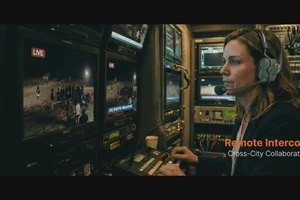
Building a qualified LED studio involves far more than simply installing physical screens; it requires extensive underlying infrastructure. A master clock synchronizes timecode across all nodes, ensuring absolute temporal consistency among multiple devices. A protected, high-throughput LAN serves as the data transmission lifeline, guaranteeing packet integrity and preventing congestion. Rendering nodes require sufficient computing power to maintain stable high-frame-rate output, while monitoring feeds allow directors and cinematographers to view near-final composites in real time. Neglecting this infrastructure will prevent stable real-time output and cause shooting interruptions, even with top-tier graphics cards.
Lens Testing Determines the Upper Limit of Visual Quality
Screen pixel pitch, camera sensor size, shooting distance, and angle collectively determine final image clarity and texture. If the camera is too close to the screen or uses a wide-angle lens, viewers may see visible pixel grids or moiré patterns. Therefore, rigorous testing with actual production lenses is mandatory before principal photography begins. This step identifies optical issues early and allows for adjustments to screen brightness, contrast, and gamma parameters, ensuring clean imagery across all focal lengths.
Collaborative Performance Testing Between Art and On-Site Teams
Epic Games' best practices emphasize that art teams and on-site technical crews must jointly conduct performance testing. Offline rendering results on workstations often fail to translate directly to LED walls due to significant differences in refresh rates, color gamuts, and dynamic ranges compared to standard monitors. Both teams must review polygon counts, light baking quality, and post-processing effects to ensure smooth real-time performance. This cross-departmental collaboration effectively prevents frame rate drops caused by insufficient asset optimization.
Lighting Compensation via the Outer Frustum
Certain shots do not require full inner frustum imagery. For areas outside the camera's field of view, the outer frustum can provide ambient lighting and reflections. This portion does not need strict synchronization with camera movement but must deliver accurate color and brightness data to simulate real-world lighting logic. This approach preserves overall scene realism while conserving computing resources. This hybrid strategy effectively balances image quality with performance, particularly for deep-focus or fast-moving shots.
Flexibility of Green Screen as a Fallback Solution
When technical limitations prevent complex shots from being completed within the inner frustum, production can revert to green screen mode. In this scenario, the inner frustum stops updating, but the outer frustum continues providing illumination, preserving authentic on-set lighting relationships. This method allows post-production teams to handle VFX in a controlled environment while avoiding the risk of reshooting entire scenes due to technical failures. It serves as a flexible fail-safe mechanism, ensuring continuity and efficiency throughout production.
Prototype Testing to Validate Toolchain Stability
Conducting small-scale prototype testing before finalizing the toolchain configuration is a core risk mitigation step. This phase aims to validate the feasibility of Unreal Engine's In-Camera VFX workflow in a physical environment. Testing focuses on confirming that nDisplay can stably distribute scenes to the display cluster and that Live Link transmits camera, lighting, and transform data without latency. The production team must run scene segments containing primary assets within a confined space simulating real shooting conditions. By observing render node performance under load, the team can identify bottlenecks causing frame rate fluctuations. For example, materials running smoothly on individual workstations may cause bandwidth congestion or VRAM overflow when connected to large LED walls. Prototype testing also helps calibrate camera parameters to ensure accurate perspective as virtual backgrounds shift with the physical camera view. This process requires close collaboration between art teams and on-set technicians to adjust scene details to match hardware limits. Large-scale production can only begin once prototype testing proves toolchain stability and visual quality. This upfront validation significantly reduces the probability of irreversible technical failures during principal photography, laying a solid foundation for efficient production.
Version Control and Iteration Management
Version control is critical during both prototype testing and principal photography. Every update to scene assets, lighting adjustments, or camera calibration changes must be documented in detail. This aids in tracing issue sources and supports post-production reviews. Standardized naming conventions and folder structures are recommended to distinguish test, rehearsal, and final delivery versions. Clear version control allows teams to quickly roll back to stable states, preventing wasted effort from erroneous modifications. Additionally, version logs should include hardware configurations and software patch levels to facilitate rapid troubleshooting of compatibility issues.
Delivery Standards and Playback QC Process
Virtual production delivery involves not only asset organization but also rigorous quality control and playback checks. Due to LED display characteristics, raw footage may contain color shifts or flickering imperceptible to the naked eye, necessitating a standardized playback workflow. After each shooting day, the technical supervisor must review footage frame-by-frame, focusing on natural edge transitions in the inner frustum and checking for banding caused by refresh rate desynchronization. Playback must also verify camera tracking data integrity to ensure every frame corresponds precisely to the 3D scene state. If moiré patterns or visible pixels are detected, the team must immediately revisit lens tests to reassess shooting distance and angle settings. Furthermore, deliverables must include complete metadata records, including lighting parameters, focal length, and distortion correction data, to enable precise compositing. For shots using green screen backups, playback must specifically check green screen uniformity and spill to ensure keying quality meets acceptance standards. This rigorous QC system ensures double verification from virtual scenes to final output, guaranteeing professional standards and artistic integrity.
Failure Warning and Emergency Response
Despite thorough prototype testing, unexpected issues may still arise on set. Common failure warnings include render node throttling due to overheating, screen tearing or blackouts from network instability, and loss of camera tracking signals. Teams should develop detailed contingency plans for these scenarios. Examples include preparing backup wired network connections, regularly cleaning render node cooling systems, and stationing dedicated tracking engineers to monitor signal status in real time. Upon detecting issues, backup plans such as switching to pre-recorded background videos or enabling green screen capture should be activated immediately to minimize downtime.
Pre-Delivery Checklist
- Confirm that camera tracking data and render engine synchronization latency remain stable.
- Verify that all lenses show no visible moiré at maximum resolution.
- Verify frame rate consistency across all nodes in the nDisplay cluster.
- Test for color shift at extreme viewing angles.
Limitations and Next Steps
This analysis is based solely on general technical facts and does not address specific client cases or budget figures. In actual projects, hardware selection and software configuration must be customized to site conditions. Please refer to the following official documentation for detailed technical specifications and implementation guidelines.