Project Assessment and Core Selling Point Extraction for Voiceover-Free, Subtitled Versions
Before launching a cross-border product video project, the marketing director must first confirm whether a voiceover-free, subtitled version is the optimal solution for the current phase. This format is not merely about saving voiceover budgets or shortening production timelines; its core value lies in eliminating the comprehension delay caused by language barriers, allowing global audiences across different language regions to absorb information through pure visual logic even on mute. A critical test must be completed during the project initiation phase: translating existing product selling points into a pure sequence of actions. If a core feature requires verbal explanation to be understood, the product may not be suitable for a purely visual version at this time, or the demonstration method needs to be redesigned.

At this stage, the brand must provide a validated selling point priority list rather than a marketing copy document. This list should include three tiers: the first tier consists of features that can be demonstrated through physical actions without text; the second tier includes parameter information that requires simple on-screen text assistance; the third tier covers abstract concepts or emotional value. A voiceover-free, subtitled version is only viable when the first-tier content is sufficient to support over 70 percent of the video duration. Forcing third-tier content into the visuals will inevitably require adding extensive explanatory subtitles in post-production, which disrupts the flow of pure visual storytelling and increases the risk of localization translation errors.
The production team must conduct a visual preview of the selling points list at the project kickoff meeting. The director or planner should use simple props or sketches to simulate the presentation of each selling point and assess on the spot for any cultural ambiguities. For instance, certain gestures may carry negative connotations in specific markets, or particular color combinations may represent taboos in local cultures. The evaluation criterion for this stage is zero language dependency, meaning a tester who understands no Chinese and knows nothing about the product is invited to watch the preview; if they cannot accurately recount the product's purpose, the visual communication has failed and the team must return to the script phase for revisions. Skipping this validation and proceeding directly to filming can easily lead to comprehension errors or even public relations risks when the final video is distributed overseas.
Structural Design and Pacing Control for Purely Visual Narrative Scripts
The script structure for voiceover-free versions differs fundamentally from that of conventional commercials. Traditional scripts use voiceovers or dialogue as timeline anchors, with visuals serving the audio; in contrast, purely visual scripts must be anchored by action continuity and visual rhythm. When writing storyboards, screenwriters must treat each shot as an independent information unit, ensuring that a single frame conveys only one clear instruction. Avoid stacking multiple operational details within the same frame, as this causes cognitive overload for viewers lacking audio guidance. The script should clearly specify the expected duration of each action and adjust the pacing density based on the average attention curve of the platform's users.
In such videos, subtitles serve solely as visual punctuation rather than information carriers. The script phase must strictly limit the word count and on-screen duration of text. It is recommended to use a keyword prompting method, displaying only extremely simple words at scene transitions or functional turning points to confirm whether the viewer's expected understanding is correct. All text appearing on screen must be incorporated into the art design scope, with font selection, layout positioning, and motion graphics rhythm highly aligned with the product's tone. Avoid arbitrarily pasting default-font explanatory text during post-production editing, as this instantly degrades the video's quality and leads overseas consumers to misjudge the brand's professionalism.
Pacing control requires building in breathing room. Without voiceover to fill the gaps, purely visual videos can easily fall into a mechanical listing of actions. The script should design specific visual pause points, utilizing product close-ups, material texture displays, or atmospheric establishing shots of the usage scenario to modulate the viewing mood. Although these non-functional shots do not directly convey selling points, they are crucial for maintaining the completion rate. The production team must annotate the specific purpose of these emotional shots in the storyboard to prevent them from being mistakenly deleted during post-production editing in the pursuit of a tighter pace. If the script is found to be high-energy throughout without any breaks, soothing segments should be added immediately; otherwise, viewers will experience fatigue midway and swipe away from the video.
On-Set Visual Enhancement Execution Standards for Product Video Shoots
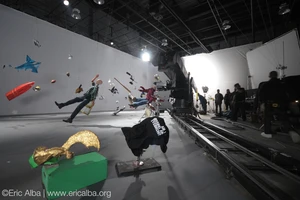
Once on set, the core task of the camera and lighting teams is to amplify the action intent from the script to the utmost extent visible to the naked eye. In a voiceover-free environment, minor operational details are infinitely magnified into comprehension barriers. The cinematographer must prioritize the clarity of action trajectories, sacrificing some artistic lighting effects if necessary. For example, when demonstrating button feedback, higher illumination than standard lighting may be required to highlight the pressing deformation; when showing liquid flow, the shutter angle may need adjustment to freeze the dynamic moment. The composition of every shot should use action readability as the highest acceptance criterion, rather than purely pursuing visual aesthetics.
The performance precision required for props and actors is far higher than in videos with audio. Lacking voiceover as a buffer for errors, any performance flaw will be interpreted as a product defect. On-set execution requires establishing a frame-by-frame playback review mechanism; immediately after completing a set of actions, review them in slow motion on the monitor to confirm that finger placement, gaze direction, and object placement angles match the storyboard exactly. For shots involving hand operations, it is recommended to use high-contrast backgrounds or wear gloves that contrast with the product to enhance silhouette recognition. If an action is difficult to see at normal speed, decisively switch to high-frame-rate shooting to reserve material flexibility for post-production speed adjustments.
Set construction must eliminate all potential visual distractions. The audience for cross-border videos comes from diverse cultural backgrounds, and books, decorations, or appliance models appearing in the scene could trigger unintended associations. The art department should decontextualize the set before filming, removing all items with distinct regional characteristics, religious symbols, or political implications. The background should remain neutral or serve the product's atmosphere, avoiding complex textures that steal focus from the subject. If shooting on a practical location is necessary, conduct a advance scout and compile a risk list, obtaining written confirmation from the client on which elements can be retained and which must be covered or replaced. Negligence in this step could result in the video being throttled or removed in specific countries.
Cross-Cultural Adaptation and Version Management in Post-Production
When handling footage without voiceovers, editors bear the responsibility of rebuilding the narrative rhythm. With no audio track to guide the edit, cut points must strictly follow action logic and visual accents. It is recommended to involve local consultants or experienced cross-border operations staff from the target market to review the rough cut, focusing on whether action transitions align with local user expectations. Operational sequences taken for granted domestically may require additional transitional shots in other cultures. The post-production team should establish a version branching system, maintaining independent project files for different regional markets to prevent accidental overwriting of approved versions during global edits.
Color grading and VFX must serve information delivery rather than stylistic showmanship. The primary goal of color grading for cross-border product videos is to restore true product colors, with atmosphere creation as a secondary objective. Over-stylized filters can lead to color discrepancy complaints or increased return rates. VFX should be restrained and concrete, used only to visualize invisible attributes like internal structures, airflow, or temperature, avoiding abstract particle effects that cause misunderstanding. All CGI elements must strictly match the lighting, perspective, and motion blur of live-action footage, as any compositing artifacts will undermine consumer trust in product authenticity. Before final delivery, export two masters—one without subtitles and one with—to flexibly accommodate future platform rule changes or multilingual expansion.
Although there is no dialogue, ambient sound and sound effects are crucial in sound design. Appropriate sound effects enhance action texture, fill silent gaps, and guide focal attention. Sound selection must avoid samples with strong cultural connotations, such as specific ethnic instruments or copyrighted film audio. Use universal foley or custom synthesized sound effects, ensuring the dynamic range meets the playback standards of major e-commerce platforms. During mixing, pay special attention to harsh high frequencies and booming low frequencies, which easily cause discomfort on phone speakers. Sound engineering should iterate synchronously with picture editing rather than being fixed at the end, preventing audio-visual misalignment or rhythmic disconnection.
Standardized Integration Strategy for Multilingual Subtitle Systems
Even for primarily voiceover-free versions, the subtitle system remains an indispensable safety net for cross-border videos. Subtitle integration should use a layered architecture, separating hardcoded subtitles from replaceable text layers. Ideally, reserve a fixed safe area in the video for keyword subtitles, keeping its position, size, and background mask consistent across all versions. This ensures visual consistency while facilitating batch replacement of multilingual text. Never burn subtitles directly into the pixels, as this requires re-rendering the entire video for every text update, drastically increasing maintenance costs and response delays.
Subtitle translation must undergo native-level proofreading and compliance review. Machine translation or non-specialist translators often miss subtle nuances in e-commerce contexts and may even violate advertising laws or platform banned-word lists. Commission localization providers familiar with the target category and platform rules for transcreation rather than simple translation. Proofreading priorities include terminology consistency, character limits, reading speed adaptation, and cultural sensitivity filtering. For longer languages like German or Russian, test in advance whether subtitle boxes can accommodate full words without overflowing or shrinking the font. If a language's subtitles inevitably disrupt visual balance, consider using icons or splitting the shot.
Subtitle motion should coordinate with the overall video rhythm, avoiding abrupt appearances or sluggish disappearances. Low-distraction effects like fade-ins or slide-ins are recommended, with duration dynamically calculated based on character count to ensure minimum readability thresholds. For key selling points, appropriately extend display time and pair with visual emphasis; for auxiliary information, let subtitles pass quickly to avoid overshadowing the main content. Test all subtitle styles on various screen sizes to confirm legibility on small mobile displays. Deliver a subtitle specification document detailing font name, size, line spacing, and safe margins for future client maintenance or third-party execution.
Delivery Acceptance Checklist and Quality Control Milestones
When accepting voiceover-free, subtitled product videos, marketing leads should discard subjective aesthetic judgments in favor of a structured verification checklist. The primary check is the silent comprehension test: with sound off and no text visible, at least three non-project personnel independently watch the video and write down the core product functions. If the majority's descriptions deviate from the preset selling points by more than two items, the video fails and must return to editing or reshoots. This test must be completed before final color grading and subtitle integration to avoid compromising due to high sunk costs.
Technical specification acceptance requires item-by-item verification against the latest official documentation of the target platforms. This includes, but is not limited to, resolution, frame rate, bitrate, color space, audio sample rate, file format, and maximum file size. Pay special attention to platform-specific requirements for first-frame covers, letterbox ratios, and subtitle safe areas. The production team should generate platform-simulated preview links before delivery, allowing clients to review the effect on real devices rather than just computer monitors. Source file delivery must include the complete project directory, proxy media, font licenses, music and sound effect licenses, and layered PSD/AE templates, ensuring the client has full asset control and secondary creation capabilities.
Legal and compliance acceptance is an insurmountable red line. It must be confirmed that all individuals appearing in the video have signed portrait rights authorization forms covering the target markets and usage periods; all background music, sound effects, fonts, and image assets hold valid commercial licenses; the display of product design patents and trademarks has received written consent from the rights holders; and advertising claims have passed regulatory review in the target countries. The absence or expiration of any of these documents must be considered a major delivery defect. Within its scope of services, ONCE can provide standardized authorization templates and compliance self-check guidelines, but the specific legal validity must still be finally confirmed by the client's legal department or external counsel. Never skip this step to meet a launch deadline, as the potential infringement risks far outweigh short-term traffic gains.
Identifying Applicability Boundaries and Recommendations for Next Steps
A voiceover-free, subtitled version is not a universal solution. When a product involves complex installation processes, precise technical parameter comparisons, the delivery of abstract service concepts, or strong emotional appeal, a purely visual format often yields half the result with twice the effort. In such cases, a hybrid approach should be considered, using the voiceover-free version as traffic-driving material paired with an in-depth narrated video for conversion. If the target market has a strong preference for localized voiceovers, such as Japan or parts of the Middle East, forcing a voiceover-free version may lead to a decline in trust. Marketing leaders must honestly assess product attributes and market characteristics at the project's outset to avoid falling into the formalistic trap of omitting voiceovers just for the sake of it.
For brands that have decided to adopt this format, the recommended next step is to prioritize organizing existing product asset libraries and competitor visual analysis reports to clarify their own visual differentiation entry points. At the same time, streamline internal approval processes and designate a single decision-maker for final sign-off on visual style and subtitle copy to prevent project revisions caused by conflicting opinions. During the initial consultation, the production team should proactively inquire about the client's long-term content plans to determine if the current project can serve as the foundation for a serialized template, thereby optimizing resource allocation and cost structure. ONCE provides production support for cross-border product videos, Amazon and Shopify product videos, and product advertising content, helping brands translate visual strategies into actionable, reusable, and verifiable commercial video assets. For specific collaboration details, please refer to the publicly listed scope of services on our website and initiate a formal inquiry through official channels.
If you are preparing a product video shoot, you can first organize your brief, reference visuals, product or company materials, delivery platforms, and copyright scope, and then review theE-commerce Product Video Services pageto translate abstract preferences into actionable production boundaries.