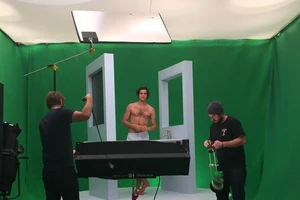
First, confirm the actual function of local talent and locations during project initiation.
During project initiation for global brand videos, teams often mistakenly treat local talent and locations as decorative elements rather than narrative tools. The faces, body language, and accents of local actors, along with the architecture, lighting, and props in a scene, directly influence international audiences' trust in the brand. During initiation, the production team must answer three questions: First, does this actor represent a typical user in the target market? Second, does this location support the credibility of the core selling point? Third, does their combination allow viewers to understand the problem the brand solves within five seconds?

The brand must prepare a local market profile detailing the target audience's age, occupation, residential area, consumption habits, and media usage. Avoid broad descriptions like 'overseas users'; be specific down to the country or city level. Upon receiving the profile, the production team must propose candidate lists for talent and locations, annotating the rationale for each selection. The criterion is that the talent and location must answer 'Why people from this country?' and 'Why this specific location?' If these cannot be answered, the project brief is insufficient.
The risk is that brands may cut costs by using domestic actors or locations and compositing overseas backgrounds in post-production. This approach occasionally works for low-budget social media shorts, but in global expansion videos, it often causes mismatches in facial proportions, skin tone, lighting, and perspective, making the content look artificial. An exception applies if the brand explicitly intends a cross-cultural mashup style and provides creative references proving it conveys the brand tone; in such cases, the stylistic intent must be clearly specified in the script beforehand.
During project initiation, local talent agency contracts and location permits must also be confirmed. The brand must provide proof of trademark registration in the target market, while the production team must verify talent likeness rights, filming permits, music licenses, and font licenses. Missing documentation may prevent the content from going live or result in its removal later. Consequently, an incomplete chain of title may lead ad platforms to reject approval or expose the brand to copyright infringement claims.
Local casting should be based on role requirements rather than superficial stereotypes.
When selecting local talent, the production team must avoid relying solely on stereotypical notions of what a foreigner looks like. The correct approach is to first analyze the character's narrative function in the script, then cast actors who can embody that function naturally. For example, if the brand sells outdoor tools, the actor needs genuine outdoor experience, not just an outdoorsy appearance. Brands should require audition tapes that include dialogue, physical movement, and improvisation, rather than relying solely on headshots or resumes.
There are three evaluation criteria: first, whether the actor is a native speaker of the target market's language; second, whether the performance conveys the brand's core emotion; and third, whether the actor appears relaxed and credible on camera. If a native speaker delivers a stiff performance, it is better to cast a non-native speaker with natural delivery, provided post-production dubbing or subtitles can address any accent issues. An exception applies when the brand specifically requests a particular celebrity or influencer; in this case, additional checks are required to ensure their public image aligns with brand values and carries no risk of negative publicity.
The production team should schedule a local casting workshop during pre-production, allowing candidates to read the script with the director, cinematographer, and brand representatives while rehearsing key actions from the shoot. This step reveals the chemistry between the actor and the setting early on, preventing the discovery of incompatibilities during principal photography. While a casting workshop adds time to pre-production, skipping it makes replacing actors during the shoot far more costly due to reshoots, pick-ups, and post-production rework.
As a consequence, poor casting may result in the final video failing internal brand approval or receiving negative audience feedback upon release. Brands should include explicit talent replacement clauses in the contract, covering conditions for replacement, cost allocation, and schedule extensions. If an actor breaches the contract during production, the production team must have a backup plan, with substitute talent activation terms predefined in the agreement.
Location selection requires distinguishing the appropriate use cases for real locations versus studio sets or CGI.
Overseas commercial productions typically source locations in three ways: real exterior locations, studio sets, or CGI/AIGC generation. Real locations offer the most natural texture and lighting but are subject to weather, crowds, permitting, and traffic constraints. Studio sets provide greater control but require high-level set design and lighting to avoid looking artificial. CGI or AIGC can create environments that do not exist in reality but demand significant post-production time and budget, along with exacting standards for realistic detail.
Brands should select location strategies based on core selling points and budget. If the selling point is product durability in real-world conditions, real locations are the best choice. If the focus is on product aesthetics or functional details, studio shooting allows precise control over lighting and angles. If the goal is to convey brand imagination or futurism, CGI or AIGC can transcend physical limitations. The key criterion is whether the location serves the message, rather than merely pursuing visual spectacle.
The risk with real locations is that unexpected events like weather changes, temporary venue closures, or resident complaints may disrupt filming. The production team must prepare backup locations before shooting and sign permit agreements with venue management in advance, specifying filming times, areas, and noise limits. Studio shooting risks set construction cost overruns due to high overseas labor and material costs; brands should require the production team to provide a detailed set construction budget covering materials, labor, transport, and dismantling.
Risks associated with CGI or AIGC scenes include copyright issues and realism. If using AI-generated scenes, brands must confirm copyright ownership and ensure no unauthorized third-party elements are included. Additionally, AI-generated scenes may have inaccurate lighting and physics, requiring manual correction in post-production. Unless the brand has clear creative references and the production team has a mature CGI workflow, extensive use of AI-generated scenes is not recommended for initial collaborations.
Production execution requires establishing localized communication and on-site decision-making mechanisms.
For overseas shoots, the production team must establish a localized communication protocol covering information flow among translators, directors, DPs, and line producers. Brand representatives need not be present throughout but must designate a contact authorized to make creative decisions. A full-crew meeting should be held before shooting to clarify shot order, actor blocking, scene adjustments, and contingency plans.
On-site decision-making hinges on the director's ability to quickly determine whether to adjust the script, modify the shooting approach, or pause when actual lighting, weather, or actor conditions deviate from the script. Brands should pre-authorize directors to make reasonable creative adjustments to avoid missing optimal shooting windows due to approval delays. The benchmark is whether the director can propose an alternative within ten minutes that preserves the core selling points.
A key risk is that local actors may have cultural sensitivities to certain actions or lines in the script, such as gestures, forms of address, or religious elements. The production team should discuss the script's cultural context with actors beforehand and welcome their modification suggestions. If an actor refuses a specific action, the director should respect this and find alternatives rather than forcing compliance, which could cause on-set conflict or negative publicity.
Metadata must be recorded for every shot on set, including timecode, shot number, actor status, scene conditions, and technical parameters, to facilitate quick asset retrieval during editing and color grading. Brands should require daily production reports detailing completed shots, remaining shots, issues, and next-day plans. Without these reports, the post-production team may struggle to verify footage completeness, potentially necessitating reshoots.
Post-production acceptance criteria must distinguish between live-action footage and composite elements.
During post-production, the team must apply distinct acceptance criteria for live-action footage, CGI elements, AIGC content, and composites. Live-action footage is evaluated based on exposure, focus, color, and audio quality. CGI elements are assessed for scale, texture, lighting, and motion matching with live footage. AIGC content is reviewed for copyright ownership, authenticity, and brand consistency. Composites are checked for natural edge blending, shadow direction, and depth of field.
Brands should require a phased post-production workflow comprising rough cut, fine cut, color grading, sound design, subtitles, and master delivery. Each phase must have defined approval milestones where brands provide feedback, rather than waiting for the final deliverable. Acceptance depends on whether each output aligns with the script's intent and brand tone, such as whether color grading enhances product texture or sound design amplifies emotional impact.
The risk is that excessive post-production revisions can cause schedule delays and cost overruns. Brands should cap revision rounds in the contract, for example allowing three rounds at the rough cut stage, two at the fine cut stage, and one during color grading. Revisions beyond the limit incur additional fees. An exception applies if the brand identifies errors in core selling points, such as unclear product demonstrations; in such cases, the production team must prioritize corrections even if the revision cap has been exceeded, though the brand will bear the extra costs.
Subtitles and voiceovers are critical components of overseas commercials. Brands must provide language versions tailored to target markets and verify subtitle translation quality rather than relying solely on machine translation. Production teams should deliver both burned-in and separate subtitle files, with standalone files intended for platform-specific uploads. Voiceovers should feature native-speaking local talent and ensure lip-sync accuracy; if synchronization fails, use subtitles or adjust editing pacing.
Delivery acceptance must be verified item by item across versions, platforms, and copyright scope.
During delivery, brands must verify each version, platform specification, and copyright scope individually. Versions include horizontal 16:9, vertical 9:16, square 1:1, and various durations such as 15s, 30s, and 60s. Platform requirements may change frequently, so brands should follow the latest official guidelines prior to publishing, and production teams should provide adjustable master files rather than fixed-format exports only.
The acceptance checklist must include: first, video file resolution, frame rate, and codec format; second, audio channel configuration, sample rate, and loudness; third, subtitle file formats and language versions; fourth, thumbnails and cover images; fifth, source files including editing projects, color grading projects, separated audio stems, and footage backups. Brands must confirm that every file opens correctly, is fully functional, and free from corruption or missing elements.
Copyright scope must be clearly defined, covering talent likeness rights, location usage rights, music licenses, font licenses, and AI-generated content rights. Brands should require copies of all licensing agreements from the production team and confirm that coverage extends to advertising in target markets. If licenses apply only to specific regions or time periods, renewal terms must be explicitly stated in the contract.
A key risk is receiving only final deliverables without source files, preventing future modifications. Contracts should specify source file delivery timelines and require brands to confirm completeness within one week of receipt. Without source files, any subsequent edits would require full reproduction at significant additional cost.
Exceptions and Alternatives
Using local talent and locations for overseas commercials is not always optimal. When budgets are extremely limited and localization demands are low, using domestic talent and locations can reduce costs but may compromise audience trust. For rapid launches requiring delivery within a week, overseas production timelines may be unfeasible; in such cases, AIGC-generated content or stock footage may serve as alternatives, provided copyright clearance and visual authenticity are ensured.
Another exception arises when core selling points are culturally neutral, such as abstract technologies or globally standardized products, where local talent and settings may distract viewers. In these cases, product close-ups, data visualization, or abstract visuals are more appropriate. Brands should assess whether localized elements genuinely enhance trust; if not, they should avoid forcing them.
Alternatives include using local models in studio sets, real locations with non-local talent, or fully AIGC-generated content incorporating local cultural symbols. Each option has pros and cons, so brands should choose based on budget, timeline, and risk tolerance. Production teams should provide at least two options for comparison, outlining the advantages and limitations of each.
Finally, brands must remember that local talent and locations are means to an end, not the goal itself. The core objective of global expansion videos is to help target audiences understand and trust the brand. If localization does not serve this purpose, even high-quality production is a wasted investment. Brands should regularly review campaign data, looking beyond click-through rates to track changes in brand search volume and reputation.
Next Steps
When preparing global expansion videos, start by defining communication goals and target audiences before deciding whether to use local talent and locations. If you proceed, follow the workflow of project initiation, casting, location scouting, filming, post-production, and acceptance, maintaining written records and acceptance criteria at every step. If budget or timeline constraints exist, opt for alternatives but clearly define risk allocation in the contract. The ONCE website lists services covering global expansion videos, overseas marketing videos, international commercials, and social media short-form content; refer to their service scope when planning project modules. However, base specific collaborations on actual discussions rather than unverified case studies.
If you are preparing a global expansion video project, gather your brief, visual references, product or company materials, delivery platforms, and licensing scope before reviewing theOverseas Marketing Video Services pageto translate abstract preferences into actionable production parameters.