Before initiating a project, determine whether an AIGC commercial addresses real communication challenges.
When considering AIGC commercials, brands often focus on technical effects first while overlooking clear communication goals. AIGC commercials suit projects requiring rapid multi-version visual assets, exploration of non-realistic scenes, or high-concept expression on a budget. If core selling points rely on authentic product features, real-world usage scenarios, or strict legal compliance, AI-generated content may risk distortion; in such cases, traditional filming or live-action combined with CGI is safer.

During project initiation, brands must answer three questions. First, what audience perception or behavior should this commercial change: enhancing brand recall, explaining complex products, or driving trials? Second, how receptive is the target audience to AI-generated imagery; if targeting professional buyers or the medical sector, overly stylized visuals may reduce trust. Third, do the distribution platform and campaign schedule allow for iteration; AIGC commercials typically require multiple rounds of style testing, so if the launch date is fixed and unchangeable, buffer time should be allocated.
During project initiation, the production team should provide a risk checklist covering generated content copyright ownership, model training data sources, personality rights, and whether the final deliverable resolution meets platform requirements. The brand must confirm these risks are acceptable and request past style samples from the production team rather than reviewing only the final video.
Moving from concept to style sample requires clear visual anchors.
The style sample is a critical step in translating abstract concepts into evaluable visuals for AIGC commercials. Brands should provide reference imagery, such as competitor ad screenshots, film clips, photography, or art style keywords; these references need not be from the same industry but must convey the intended visual mood and texture. For example, to achieve a futuristic tech aesthetic, reference the metallic textures of hard sci-fi films rather than simply asking AI to generate a robot.
The production team should break down the creative script into visualizable elements, including subject form, environmental atmosphere, lighting direction, color palette, camera movement rhythm, and material details. Each element must be tested individually in the style sample rather than generating the entire ad at once. For instance, test the protagonist's appearance under various lighting conditions first, then scene background texture and perspective, before combining them into complete shots.
When reviewing style samples, brands should focus not just on single-frame aesthetics but on whether the visuals consistently support the narrative. If character expressions appear unnatural or object motion violates physics, these issues are difficult to fix in post-production and should be addressed during the sampling phase. The production team must record parameters and generation seeds for each revision to trace the causes of visual changes.
Integrating live-action footage with AI-generated assets during production.
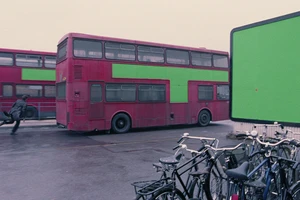
AIGC commercials do not entirely eliminate filming; many projects require live-action footage as a foundation for AI generation. Brands must specify which elements require live shooting, such as actual product close-ups, actor facial close-ups, or location establishing shots; using this footage to train models or as generation references significantly enhances final visual realism. Relying solely on text-to-video generation may result in visuals that lack distinctive brand assets.
During production, the team should allocate sufficient time for capturing assets intended for AI generation. For example, shoot products from multiple angles and under various lighting conditions to allow selection of optimal inputs for the model. Additionally, record on-set lighting color temperature, lens focal length, and camera settings, as this data helps the AI generate more consistent virtual environments. If shooting conditions are limited, such as inability to travel overseas, AIGC can generate backgrounds while foreground subjects are still filmed live to ensure quality.
The primary risk lies in the integration of live-action and AI-generated footage. Brands should require the production team to deliver an integration test clip within one week of wrapping principal photography to verify consistency in lighting, color, and perspective. If the test clip shows obvious visual disconnection, adjust the shooting plan or generation parameters immediately rather than deferring fixes to post-production. Otherwise, the final video may suffer from jarring inconsistencies, such as sharp subjects against blurry backgrounds.
Version control and style iteration pacing in post-production.
Post-production for AIGC commercials requires multiple rounds of style iteration. Brands should agree on specific deliverables for each round with the production team, such as static style frames in the first round, motion test clips in the second, and a rough cut with audio in the third. Each iteration requires clear feedback criteria to avoid endless revisions.
Version control is the most easily mismanaged aspect of post-production. The production team should use version numbers and dates to log every output, saving generation parameters, model versions, and prompts. When providing feedback, brands should specify issues precisely, such as unnatural reflections in a character's left eye, rather than making vague complaints about image quality. Additionally, brands must verify whether modifications affect overall stylistic consistency, as localized changes may cause mismatches in other shots.
Sound design is often overlooked in AIGC commercials, yet it significantly influences the audience's perception of visual realism. Brands should require the production team to design ambient sound, foley, and music concurrently during post-production, rather than simply adding background music at the end. Appropriate audio can mask minor visual imperfections in AI-generated imagery. Conversely, if the audio does not match the visual rhythm, it will amplify visual flaws.
Verify technical specifications and copyright terms item by item during delivery acceptance.
Delivery acceptance is the most critical phase of an AIGC commercial project; brands must establish an itemized checklist rather than relying solely on the final video's appearance. This checklist should cover resolution, frame rate, color space, codec format, subtitle tracks, audio loudness, master versions, and source file inventories. Each item requires practical testing, such as checking for color banding or compression artifacts on target playback devices.
Copyright terms are a key focus during acceptance. Brands must confirm that the models used for AI-generated content permit commercial use, that training data excludes third-party copyrighted material, and that ownership of the final video is clearly defined. Updates to a model provider's terms of use could affect the legality of previously generated content; therefore, brands should request screenshots or written confirmation of the latest terms from the production team.
Source file delivery is equally important. Brands should obtain all project files, including generation scripts, parameter settings, raw assets, project files, and uncompressed masters, to facilitate future edits or regeneration. If the production team provides only the final video, brands may become dependent on the original team for subsequent updates, increasing costs and timelines. During acceptance, test source files for completeness and usability, such as opening project files to ensure no links are missing.
Clear determination of applicable boundaries and unsuitable scenarios.
AIGC commercials are not a universal solution and have distinct limitations. When a brand needs to showcase authentic product details, such as gemstone cuts, food textures, or precision mechanical structures, AI generation may fail to match the quality of live-action footage. Similarly, if an ad requires conveying genuine human emotion, such as real stories in public service announcements, AI-generated facial expressions may lack impact, making traditional filming the better choice.
Another unsuitable scenario involves strictly regulated industries, such as healthcare, finance, and children's products. Advertising content in these sectors requires regulatory review, and AI-generated visuals may not provide a complete chain of evidence, such as proof of product efficacy or clinical data visualization. Without these materials, brands cannot pass compliance reviews, regardless of visual quality.
Additionally, if a brand has very limited budget and timeline with no time for multiple style iterations, AIGC commercials may not be suitable. AI generation requires trial and error; initial results are often suboptimal and demand time for refinement. If the project must succeed on the first attempt, traditional filming or licensing stock footage may be safer options.
Recommended Next Steps and Internal Evaluation Actions
Before committing to an AIGC commercial, brands should validate the workflow with a low-cost pilot project. Select an existing product video and use AI tools to generate a 30-second style sample to assess visual quality, generation speed, and internal feedback. This test does not require a full production budget but helps the team understand the strengths and limitations of AI generation.
Meanwhile, brands should prepare a detailed creative brief covering communication goals, audience profiles, key selling points, visual references, prohibited elements, and delivery platform requirements. The more specific the brief, the more accurately the production team can generate style samples, reducing communication overhead. Missing critical details, such as vertical aspect ratios or subtitle languages for target platforms, may necessitate rework later.
Finally, when contracting with the production team, brands should clearly define acceptance criteria and revision limits for each phase. AIGC projects can easily fall into endless revisions due to the randomness of generated outputs. Contractual agreements protect both parties and keep the project within manageable bounds. If test results are unsatisfactory, brands can cut losses early and pivot to traditional production methods.
If you are preparing an AIGC commercial project, start by organizing your brief, visual references, product or corporate materials, delivery platforms, and copyright scope before reviewingthe AIGC Video Services pageto translate abstract preferences into actionable production parameters.